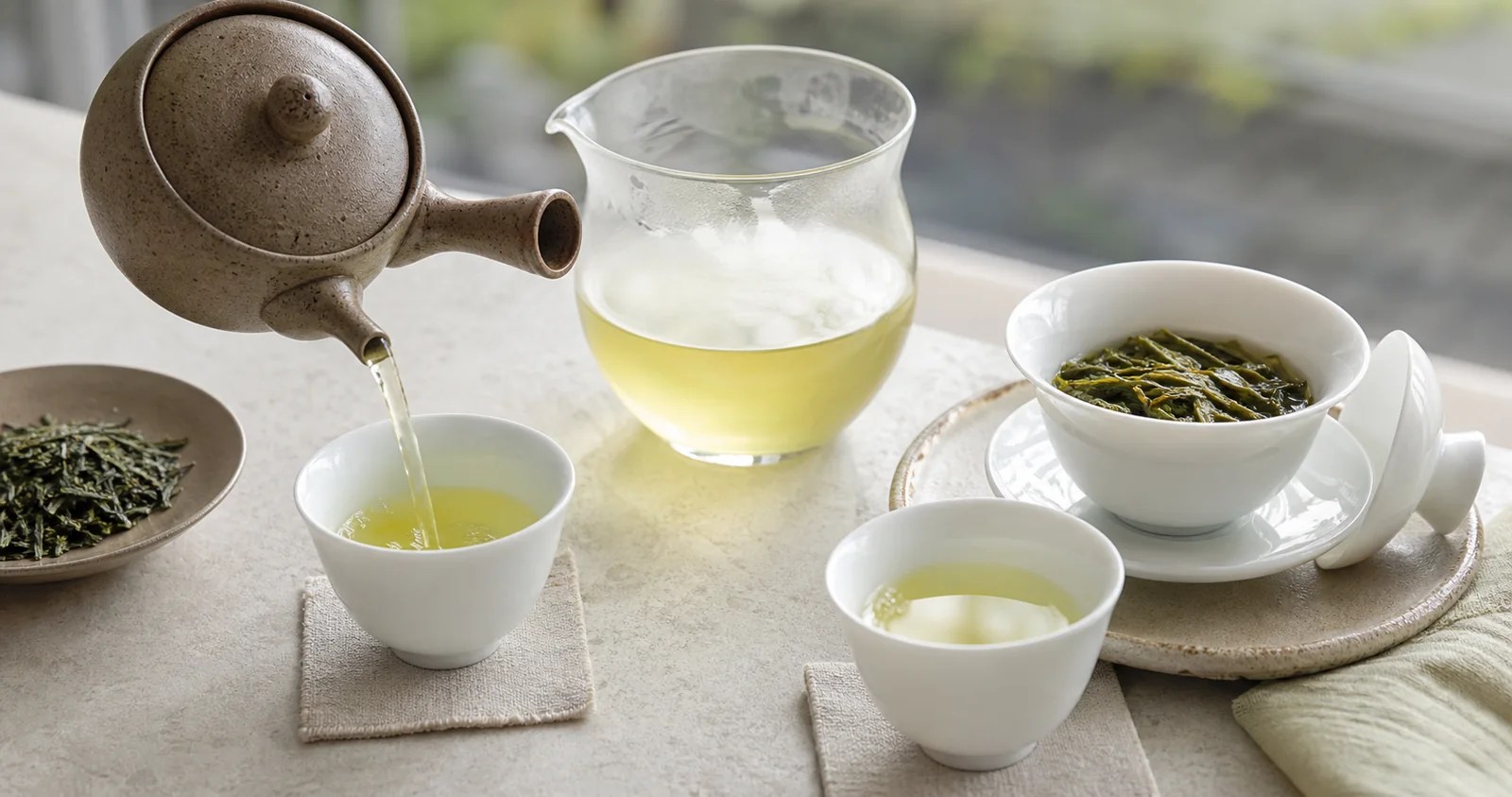
Green tea is not fragile glass. Learn why steamed and pan-heated leaves behave differently, then use temperature and time as adjustable tools.
8 minutes read · Tea Families
Green tea has acquired an intimidating rulebook: never use boiling water, never steep beyond a minute, never make a mistake. Fear is not a useful tasting tool.
Green teas are heated relatively early in processing to limit the enzyme activity that drives oxidation. That shared step creates a family, not one flavor. Leaf material, heat method, shaping, drying, storage, and brewing can produce cups that are marine, nutty, grassy, floral, savory, sweet, brisk, or powerfully bitter.
Steamed, pan-heated, and beyond
Many Japanese green teas are steamed, a method often associated with vivid color, fresh vegetal aroma, and leaves that may become fine or fragmented. Many Chinese green teas are heated in pans or rotating drums, often bringing chestnut, bean, or toasted impressions. These are broad tendencies with many exceptions.
The important lesson is that broken-looking leaf is not automatically low quality. Deep steaming can create fine particles in excellent sencha. A flat Longjing-style leaf and a rolled gunpowder-style leaf need different visual expectations.
Why bitterness happens
Hot water and time extract many compounds at different rates. Caffeine contributes bitterness; catechins contribute bitterness and astringency; amino acids contribute savory and sweet impressions. Particle size, ratio, agitation, and water chemistry change what arrives in the cup.
A study comparing steeping conditions found significant effects from time, temperature, and particle size, with milled leaf tending toward more bitter and astringent sensory results (PubMed). That does not mean “hotter is bad.” It means hotter water is a stronger extraction choice.
Begin with a forgiving recipe
For a green tea without specific maker instructions, try:
- 2.5 grams of leaf;
- 250 milliliters of water;
- 80°C / 176°F;
- 90 seconds;
- a wide basket or small pot that can drain completely.
Taste as it cools. If thin, add time before adding heat. If sharply bitter, shorten the steep or lower temperature. If aromatic but weak, add a little more leaf. Change one variable at a time.
For a concentrated Japanese-style infusion, a small kyusu or shiboridashi, more leaf, cooler water, and shorter volume can emphasize sweetness and umami. For a sturdy pan-fired tea, hotter water may bring satisfying aroma. Follow the specific leaf, not a category superstition.
Water can hide the light
The same tea can look and taste different across cities. In controlled green-tea tests, water mineral content and pH affected aroma compounds, taste, and liquor color; lower-mineral water near neutral pH was often favorable for brewing (Food Chemistry: X).
If a trusted tea stays dull or develops a surface film, compare:
- tap water;
- filtered tap water;
- a moderate- or low-mineral bottled water.
Do not chase “pure” water at any cost. Distilled water can produce a flat cup. The goal is a compatible water, not zero minerals.
Freshness and storage matter
Green tea is especially vulnerable to heat, humidity, oxygen, light, and odor. Research on Longjing aroma during storage identifies temperature, humidity, light, and oxygen among factors in deterioration (storage study).
Buy quantities you can drink while lively. Keep the inner package tightly closed inside an opaque, odor-free container in a cool cupboard. Refrigeration can help some factory-sealed teas, but repeated removal can cause condensation; let a sealed package return to room temperature before opening. Once open, simplicity and steady use often beat elaborate storage rituals.
Iced and cold approaches
For iced tea, brew slightly concentrated and pour over a measured amount of ice, or cool promptly after brewing. For cold brew, combine leaf and cold potable water in a clean covered vessel and refrigerate. Start around 5–8 grams per liter for 6–10 hours, then strain and keep refrigerated.
Long cold contact does not mean caffeine-free. Extraction differs from a brief hot steep, but caffeine remains possible and total amounts are hard to predict without testing.
Look for liveliness, not one color
Some green teas show Being Tea Co.’s “golden light”; others are yellow-green, almost clear, or hazy with tiny particles. Read aroma, taste, texture, and finish together. A cup that tastes sweet, vivid, and clean need not pass a visual purity test.
Green tea becomes easier when the rule changes from “do not ruin it” to “observe and adjust.” The leaf is not waiting to punish you. It is giving feedback.


Leave a comment