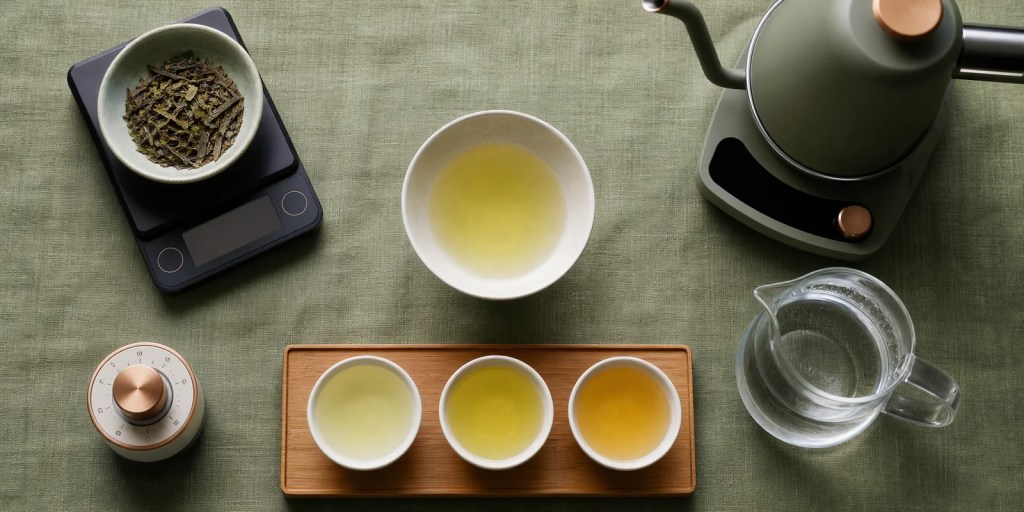
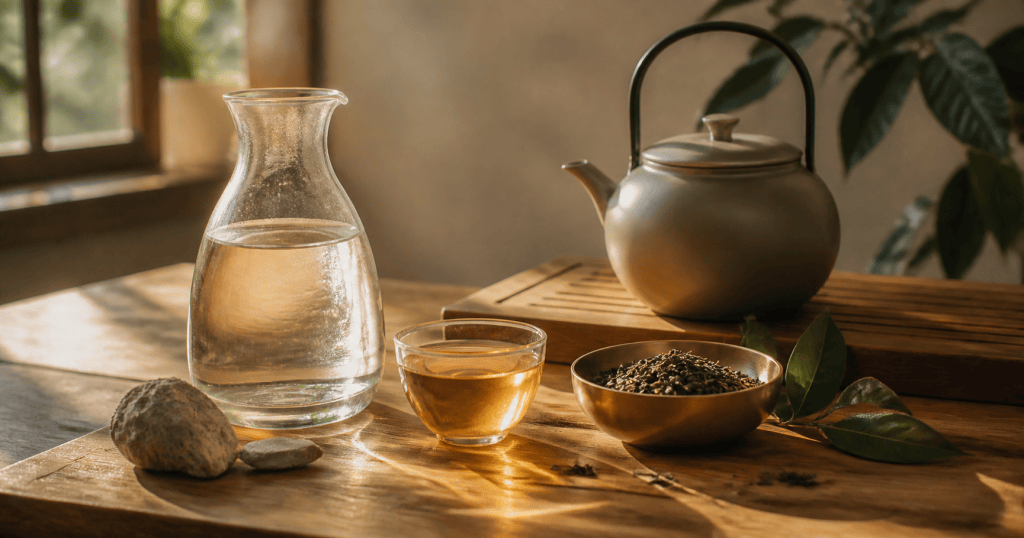
Two cups of the same tea, brewed the same way in two kitchens, can taste noticeably different. Before blaming the leaf or the brewer, consider the ingredient that makes up more than 98 percent of the cup: the water.
What water actually changes
Water is not neutral. Its dissolved minerals, pH, and temperature all shape how tea compounds extract and how the result tastes. A 2023 peer-reviewed study of brewing water and green tea found that mineral content measurably shifted both the chemistry of the infusion and how panelists rated it—harder water pushed the liquor darker and the taste heavier, while softer water kept it lighter and clearer. The study is one data point, not a universal law, but the direction matches what many brewers notice at home.
Temperature and time matter alongside minerals. Controlled steeping-condition research shows hotter water and longer contact extract more catechins and caffeine—which is exactly why a green tea brewed with boiling water for five minutes tastes harsher than the same leaf at a lower temperature for two.
A practical way to test your own water
You do not need a laboratory. Brew the same tea, same ratio, same time, twice: once with your tap water and once with an inexpensive still bottled water. Taste them side by side and write down one difference. If the bottled-water cup is clearly brighter or sweeter, your tap water is a variable worth attention; if you cannot tell them apart, your tap water is fine and the experiment cost one extra cup.
Boundaries worth keeping
None of this makes any water a health product. Filtered, bottled, or mineral-adjusted water changes taste, not safety or medical effect, and this page is not advice about what water to drink. Start from fresh, potable water, change one variable at a time, and let your own comparison—not marketing—decide what earns a place in your kettle.
Sources
Brewing-water and green tea study (2023): PMC10192933
Steeping conditions, catechins and caffeine: PubMed 26017324
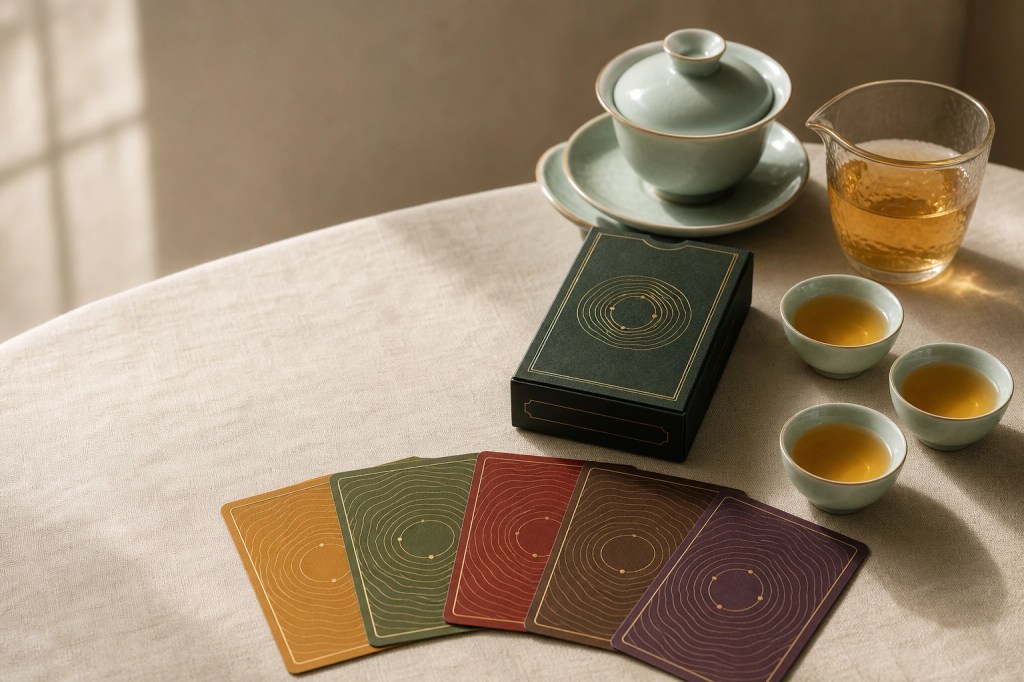
Between Steeps is a tea-and-conversation card deck in open development. This is the first development note in what will be a running series: what exists, what is being tested, and what remains undecided. No orders, preorders, reservations, or payments are open, and nothing on this page is finished retail packaging.
Where the deck stands
The working playtest deck is 54 cards, sequenced to move a table from easy laughter toward sensory attention, stories, and optional deeper reflection. A free 12-card public sampler is available as a PDF, and the founder’s playtest interest list is open. The deck is designed for adults, 18 and up.
What we are testing first
Three questions lead this round of testing. Does the sequencing actually work at a real table, or do groups skip ahead to the deeper prompts before trust has formed? Do the sensory cards work with whatever tea people already have, or do they quietly assume a cabinet of loose leaf? And which cards get set aside unused—the honest signal that a prompt reads better than it plays.
How to help
Download the sampler, play a session, and send three sentences through the feedback form on the playtest page: who played, what worked, and where a card landed wrong. Sessions that went badly are at least as useful as sessions that went well.
Production research continues in parallel—an individually designed card face for every card rules out several print-on-demand options, and a physical proof copy will be ordered and inspected before any edition is described as approved. Future notes will report those results as they actually happen.
Green, white, yellow, oolong, black, and dark tea begin with Camellia sinensis. Craft—not a different “tea plant” for every color—creates the paths we meet in the cup.
7 minutes read · Foundations
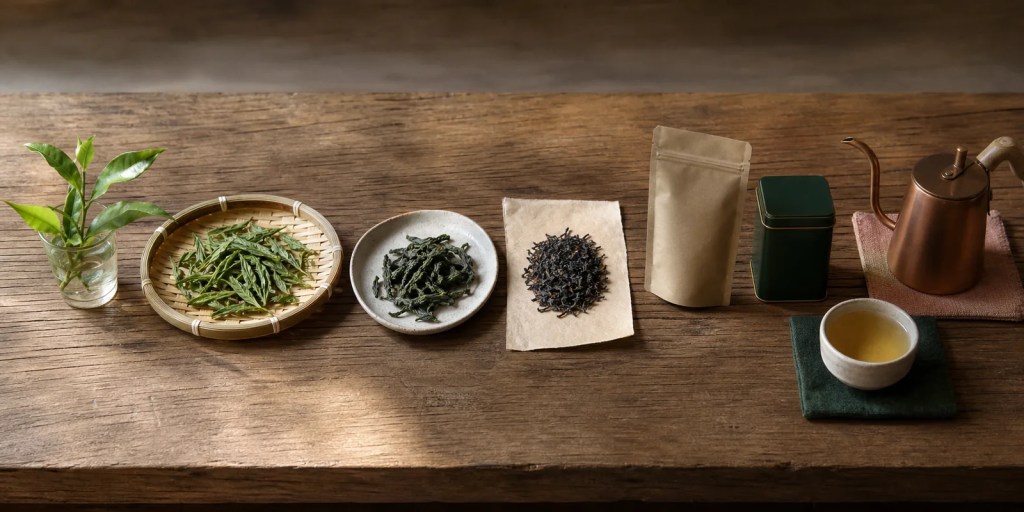
The tea shelf can look like a collection of unrelated plants. Silver buds sit beside jade-green needles; rolled oolong looks like small green stones; black tea appears coppery and dark; a pressed pu-erh cake resembles something from an archive. Yet the traditional tea families begin with the same species: Camellia sinensis.
The Royal Botanic Gardens, Kew describes tea as an evergreen shrub whose picked leaves may be baked, steamed, rolled, and dried. The U.S. National Center for Complementary and Integrative Health makes the essential distinction plainly: green, black, oolong, and white teas all come from Camellia sinensis, while “herbal teas” come from other plants (NCCIH).
That does not make peppermint, rooibos, chamomile, or chaga lesser drinks. It simply gives us useful language. In this journal, tea means Camellia sinensis. We will use tisane or herbal infusion when the brewed plant is something else. Precision lets us appreciate both without asking one category to pretend to be another.
Six broad families
Tea is not sorted by the color of the dry leaf alone. It is sorted mainly through processing traditions. UNESCO’s account of China’s traditional tea knowledge identifies six broad categories: green, yellow, dark, white, oolong, and black tea (UNESCO Intangible Cultural Heritage). These are capacious families, not six single recipes.
White tea is generally allowed to wither and dry with comparatively little manipulation.
Green tea is heated early to limit enzymatic oxidation, then shaped and dried.
Yellow tea follows a green-tea-like path with an additional controlled “yellowing” or sealed-resting stage.
Oolong tea is deliberately bruised, rested, and heated to create a wide spectrum of partial oxidation and aromatic development.
Black tea is more extensively oxidized before drying. In Chinese terminology it is commonly called red tea, after the color of the liquor.
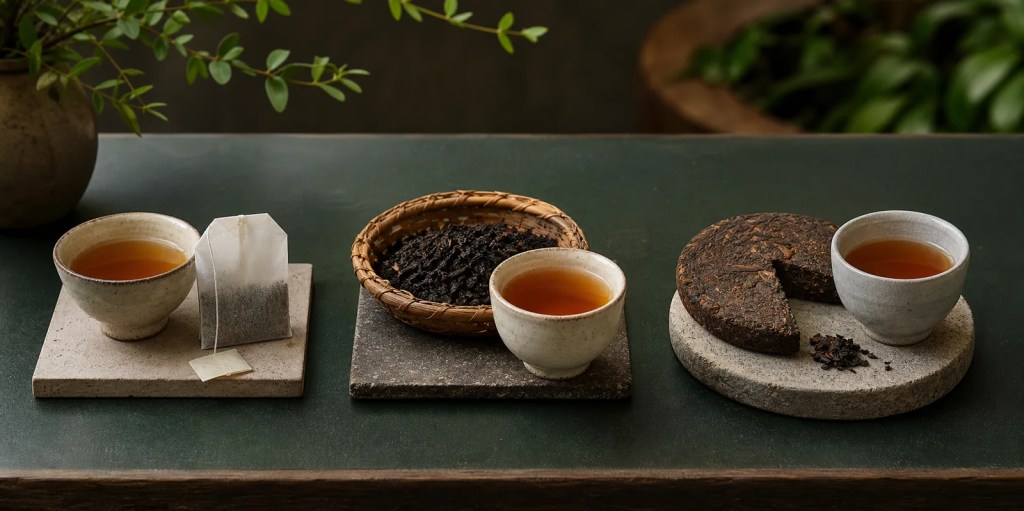
Dark tea includes post-fermented traditions in which microbial activity and later transformation matter. Pu-erh is one important member, not a synonym for every dark tea.
“Oxidation” and “fermentation” are often blurred in casual tea language. Oxidation is the enzyme-driven browning that can begin when leaf cells are disrupted and exposed to oxygen. Microbial fermentation involves microorganisms. Some historical trade vocabularies call oxidation “fermentation,” but keeping the processes separate helps us understand what makers are actually doing.
The cultivar and the place still matter
One species does not mean one identical raw material. Tea has many cultivated varieties, local populations, and named cultivars. Elevation, shade, season, weather, soil, plant age, plucking standard, and farming choices all influence the leaf that enters the factory. Then the maker decides how far to wither it, how firmly to roll or bruise it, when to apply heat, how to roast it, and whether it should rest or age.
This is why “green tea tastes grassy” and “oolong tastes floral” are starting points, not laws. A steamed Japanese green can suggest sea greens and broth; a pan-fired Chinese green might suggest chestnut. A lightly oxidized oolong may be intensely floral, while a roasted Wuyi oolong can lean mineral, fruit-skin, and toast. Category tells us something about the route. It does not finish the tasting note for us.
A better first question
When meeting an unfamiliar tea, begin with five questions:
What plant material is this—tea or a tisane?
Where was it grown?
When and how was it harvested?
What processing path did it take?
How does the seller know?
Those questions are more useful than asking whether a tea is “fancy.” They move attention from marketing language toward plant, place, labor, and craft.
The Food and Agriculture Organization reports that tea supports millions of growers, workers, and families, with smallholders producing a major share of the world’s tea (FAO International Tea Day). Every finished leaf therefore carries both a biological story and a human one.
The next time six teas look impossibly different, place them side by side. Notice their shapes. Smell the dry leaves. Add water and compare the opened leaf. The lesson is not that all tea is the same. It is that astonishing difference can begin from one living plant.
Dear Friends,
Due to my love for Tea I am going to start sampling different brands and varieties of Tea and trying different Tea sets.
Here is the link to my first Video, brewing Chaga Tea: https://youtu.be/Si7GzEAFvGk
The videos will be published to Youtube and then embedded in the posts under “Video Reviews” in the Menu in the Top Right corner!
When you find a practice that works for you, you use it.
You enjoy the fruits of your practice, by practicing.
This is me, taking a practice that works for me, the practice of Drinking Tea, and using it to create space and enjoy community.
I hope to use this space to discuss things I am interested in, in the Now, but mainly to Talk about Tea.
I would love to try different kinds of Tea, Tea Pots, Cups, anything relating to Tea and learn the culture and habits behind them, posting videos of my Experience.