Price and leaf size can reveal something—but neither tells the whole story. Here is a more useful way to judge value from an everyday bag to a provenance-rich aged tea.
8 minutes read · Buying Tea
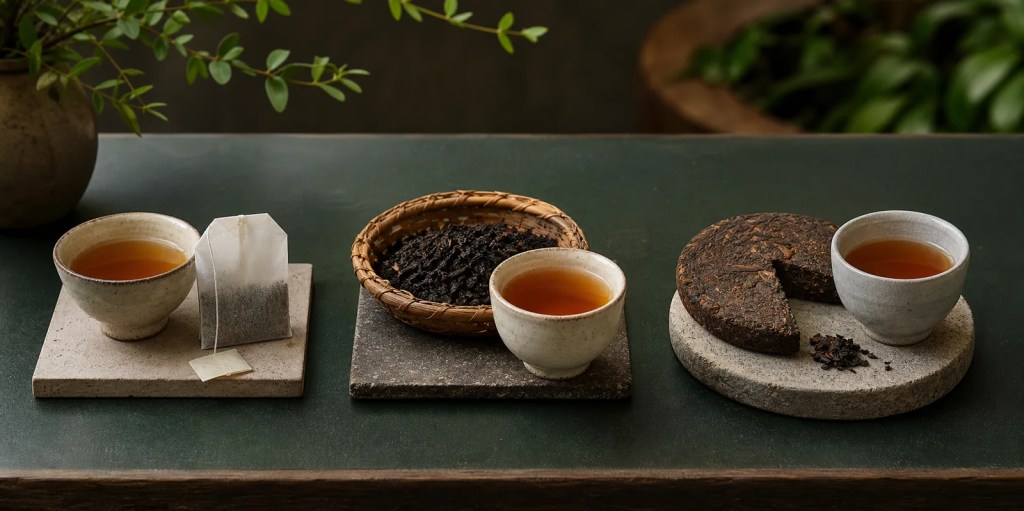
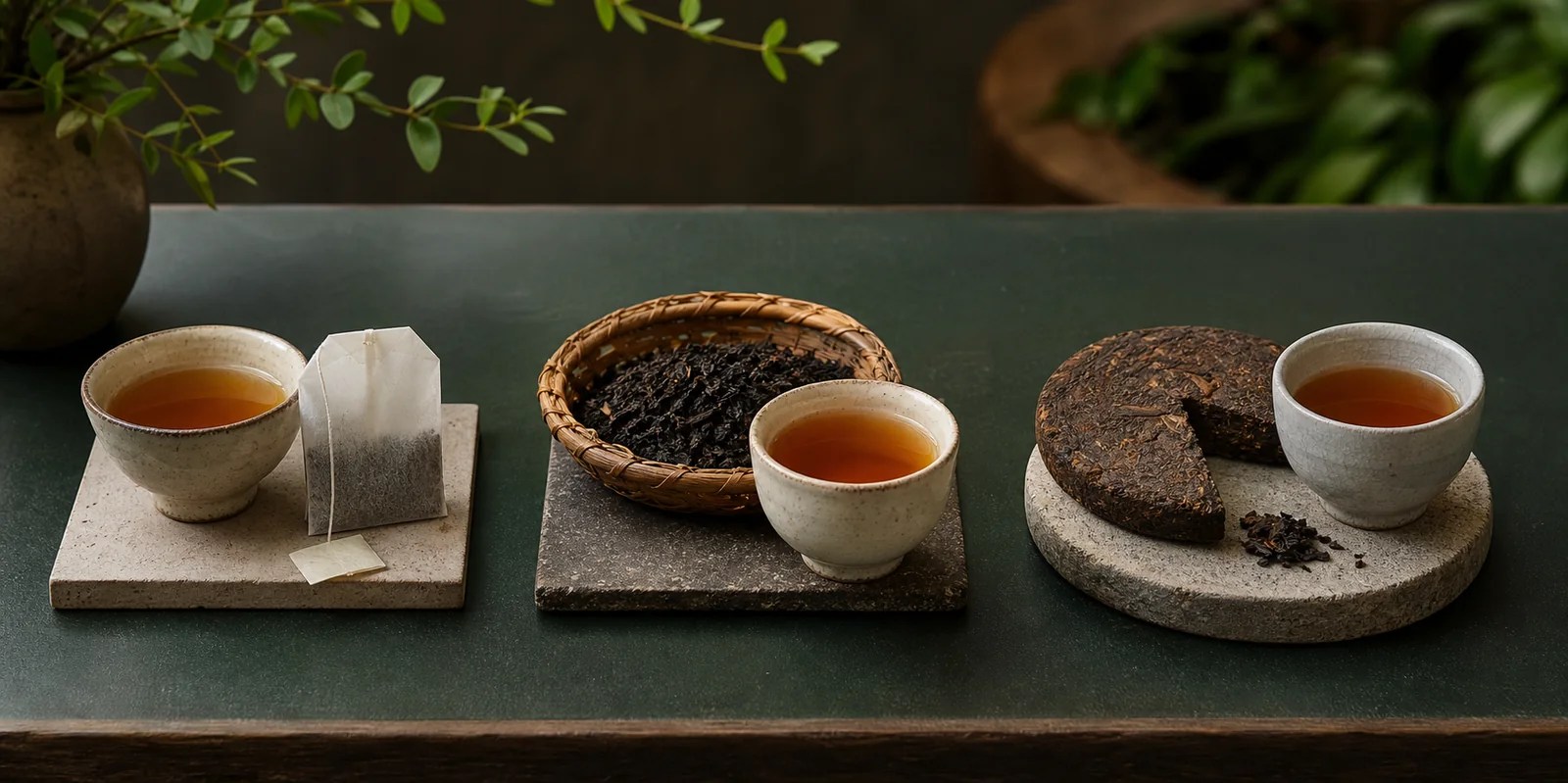
It is tempting to draw tea as a staircase: bag at the bottom, loose leaf in the middle, old pu-erh at the top. That picture is easy—and wrong often enough to mislead.
A fresh, thoughtfully sourced tea bag can make a more satisfying cup than stale “premium” loose leaf. A broken-leaf breakfast tea may be exactly right with milk. A costly cake of pu-erh may be poorly stored, falsely aged, or simply not to your taste. Quality is not one vertical ladder. It is a set of relationships among material, craft, freshness or storage, brewing purpose, transparency, and price.
What a tea bag actually changes
Tea bags commonly contain smaller particles because those particles infuse quickly. Research on tea-bag infusion found that reducing particle size increases extraction rate, while the bag’s geometry and how leaf contacts water also matter (Swelling and infusion of tea in tea bags).
Faster extraction can produce strength and color quickly. It can also make timing less forgiving: bitterness and astringency may arrive fast. A cramped bag gives expanding leaf less room than a basket infuser, but “bag” does not identify the garden, harvest, or care of manufacture.
Choose a bag when convenience, portability, consistent strength, or easy cleanup matters. Judge it by aroma, honest labeling, freshness, and the cup it makes—not shame.
What loose leaf makes possible
Loose leaf lets you see and dose the material. A roomy basket, pot, or gaiwan gives larger leaves space to unfurl and makes repeated infusions practical. It also lets you inspect uniformity, stems, buds, roast, breakage, and the spent leaf.
None of that guarantees excellence. “Loose leaf” is a format, not a protected quality claim. Flavored commodity tea can be sold loose; exceptional tea can be packed in a sachet. The advantage is access and control.
What “specialty” should add
Specialty tea has no single globally enforced definition. For Being Tea Co., the term becomes useful when a seller adds specific, verifiable information:
- country and region, preferably garden or producer when appropriate;
- tea family and cultivar when known;
- harvest season or date;
- processing style;
- storage history for aged tea;
- brewing guidance that fits the leaf;
- a price that can be explained without magical claims.
Traceability does not guarantee that you will love the flavor. It gives you a fair chance to understand and repeat the experience.
Why whole leaf is not the whole answer
Leaf grading systems often describe physical size and form. They are not universal flavor scores. Smaller particles expose more surface area and tend to extract faster; larger or intact leaves often infuse more gradually. But some excellent styles are intentionally small, broken, rolled, chopped, or compressed.
Ask whether the appearance is appropriate for the style. Needle-shaped tea should not be judged by the same visual rules as deeply steamed sencha, CTC Assam, or a compressed dark tea.
What age can—and cannot—add
Aging is meaningful for teas made and stored for transformation, including many raw and ripe pu-erhs and some other dark, white, or roasted teas. Time alone adds no virtue. Storage conditions, starting material, processing, authenticity, and personal preference matter.
Studies of pu-erh document chemical and sensory changes during storage, but researchers also caution that the familiar “older is better” belief is empirical and not uniformly predictable (study of long-term ripened pu-erh aging). “Generational” is evocative marketing unless a seller can establish dates, custody, and storage.
For an aged purchase, request:
- production year and maker;
- raw or ripe process;
- region and material, if known;
- where and how it was stored;
- whether the seller has tasted this batch;
- a sample before a full cake, when possible.
A five-part value test
Instead of ranking formats, score a tea for your purpose:
Clarity: Does the seller explain what it is? Condition: Is it fresh or well stored? Craft: Does the processing suit the intended style? Cup: Does it taste compelling at a workable recipe? Cost per session: How many satisfying cups or infusions does the purchase yield?
An expensive oolong that produces eight beautiful small infusions may cost less per session than its package price suggests. A low-priced bag you genuinely enjoy may be excellent value. The point is not to spend more. It is to know what the money is buying.
Tea education should expand pleasure, not create a new status contest. Keep the bag when it serves you. Explore loose leaf for control. Pay more when provenance, labor, craft, rarity, or trustworthy storage justifies it. And reserve the highest rung for no object at all: the cup you can understand and enjoy.


 Being Tea Co