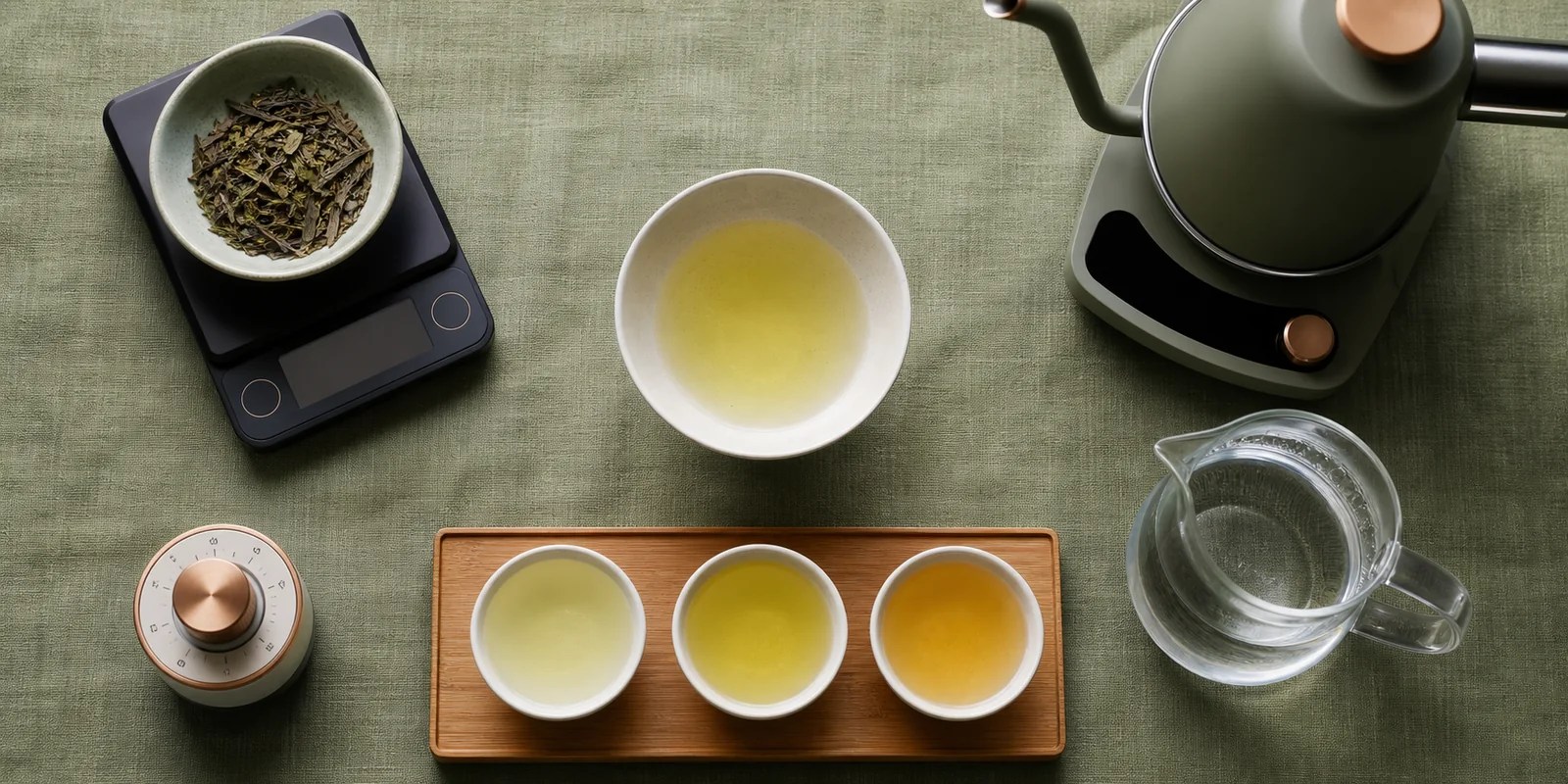
A repeatable cup begins with four variables and one modest habit: change only one thing at a time.
8 minutes read · Brewing
Brewing advice often arrives as a command: green tea at one temperature, black tea at another, oolong for exactly so many seconds. Recipes are useful starting points. They become limiting when we mistake them for laws.
Leaves vary in cultivar, season, particle size, compression, roast, age, and processing. Water varies by place. Vessels lose heat differently. Your preferred strength is not a laboratory constant. A reliable brewer does not memorize one perfect chart; they learn how to run a small experiment.
First, separate recipe from method
A recipe records what you did: grams, water volume, temperature, time, vessel, and number of infusions. A method describes the larger approach.
In a larger-vessel or “Western-style” brew, a modest amount of leaf steeps for minutes and usually yields one or a few infusions. In concentrated, repeated-infusion brewing—often associated with Chinese gongfu tea—a higher leaf-to-water ratio meets shorter steeps, producing a sequence of changing cups. Grandparent-style brewing leaves tea in the drinking vessel and adds water as needed. Cold brewing uses cool water and long contact, ideally under refrigeration for food-safety prudence.
These are tools, not rankings of sophistication.
The four controllable variables
Leaf-to-water ratio. Weighing leaf is the fastest route to repeatability. A useful first trial for a larger pot is about 2–3 grams per 250 milliliters; for a small repeated-infusion vessel, 4–7 grams per 100 milliliters is a broad starting range. Those are test points, not universal standards. Bulky white tea and dense rolled oolong occupy volume differently, which is why a scale helps.
Water. Tea is mostly water in the cup, and mineral composition matters. A controlled study found that water pH and minerals changed green tea’s color, taste, and volatile aroma profile; lower-mineral water near neutral pH often performed well for aroma (brewing-water study). Avoid distilled water as an automatic answer—it can taste flat. Compare your tap water, filtered water, and one moderate-mineral bottled water.
Temperature. Hotter water generally extracts soluble material more quickly, including compounds we experience as bitterness, astringency, sweetness, and aroma. Delicate is not a synonym for “must use cool water,” and dark is not a command to boil. Begin with the maker’s guidance, then adjust for the result.
Time. Time works with all three variables above. More leaf often calls for shorter steeps. Smaller particles infuse faster. Compressed tea may begin slowly and open over successive infusions. Research on white and green teas shows that time, temperature, and particle size change both extraction and sensory experience (steeping-conditions study).
The one-variable rule
If a cup is too bitter and you simultaneously lower temperature, shorten time, halve the leaf, and change the water, you may improve it—but you will not know why.
Instead:
- Record the baseline.
- Name the problem in sensory terms.
- Change one variable.
- Taste at the same drinking temperature.
- Keep or reject the change.
“Too strong” is ambiguous. Does it mean bitter, drying, roasted, smoky, thick, or highly aromatic? Precise language suggests a precise adjustment.
A practical first-pass chart
Use these broad starting points for a 250-milliliter covered vessel, then follow the leaf:
| Tea family | Water | Time | Leaf | |—|—:|—:|—:| | Green | 70–85°C / 158–185°F | 1–3 min | 2–3 g | | White | 80–95°C / 176–203°F | 3–5 min | 2.5–4 g | | Oolong | 85–100°C / 185–212°F | 2–4 min | 3–5 g | | Black | 90–100°C / 194–212°F | 3–5 min | 2–3 g | | Dark / pu-erh | 95–100°C / 203–212°F | 2–5 min | 3–5 g |
These ranges are intentionally wide. A Japanese gyokuro may invite much cooler, concentrated brewing; a tightly rolled oolong may thrive in a small vessel with very short repeated steeps. The package, producer, and your palate outrank this table.
Do not use brewing myths as caffeine controls
A quick rinse does not reliably “decaffeinate” tea. Caffeine extraction varies substantially by product and conditions. A study of commercial teas found 14–61 milligrams per 6- or 8-ounce serving and no simple category trend across white, green, and black teas (Caffeine content of brewed teas).
If caffeine matters, drink smaller servings, choose fewer sessions, avoid late-day tea, seek tested products, or consult a clinician for personal guidance. Do not assume cooler water or the first discarded steep makes the rest caffeine-free.
Keep a tiny log
Write one line:
Tea / grams / milliliters / water / temperature / time / result / next change
After five brews, you will know more about that tea than a generic chart can tell you. Brewing becomes calm not because uncertainty disappears, but because you have a way to work with it.


Leave a comment