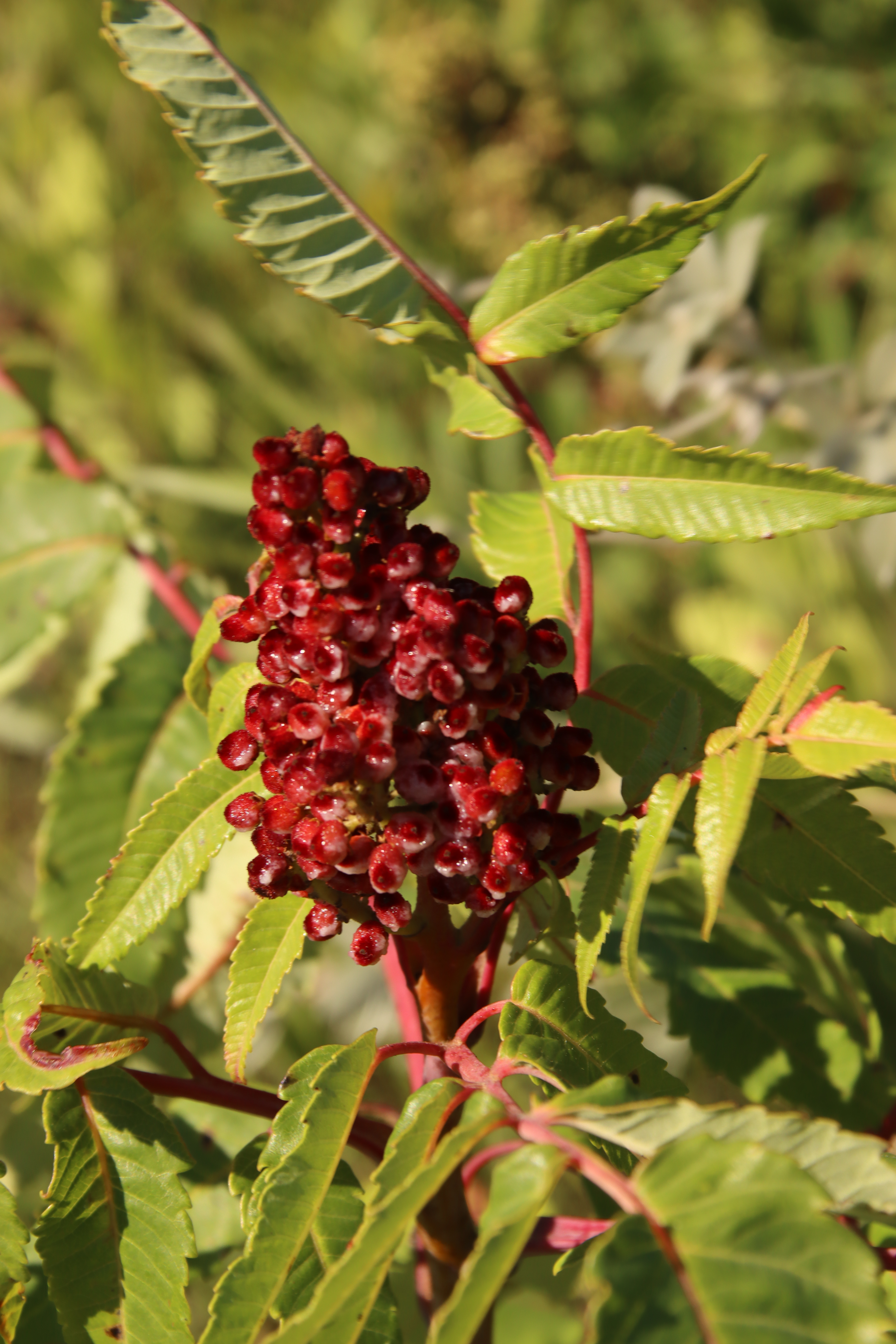
A tart cold-infusion fruit whose red upright cluster must be distinguished from white-fruited poison sumac and from other sumac species.
Being Tea Co provides education, not medical advice, treatment, or positive plant identification. Natural does not mean risk-free. Never ingest a wild plant or fungus from a photograph, app result, common name, or this website alone.
Herbs can cause allergic reactions and interact with medicines. Pregnancy, breastfeeding, childhood, surgery, seizure history, kidney or liver conditions, and other health factors can change what is appropriate. Ask a qualified clinician or pharmacist about your own situation.
At a glance
| Scientific name | Rhus glabra |
|---|---|
| Exact part | Mature red hairy drupes from an upright fruit cluster |
| Safety class | Guided food use · field identification required |
| Source | Expert-confirmed ripe fruit from a permitted clean site |
| Season | Fruit generally ripens September to October and often persists |
| Broad region | Most of the contiguous United States, southern Canada, and Mexico; not a default Alaska forage |
Research lead—not positive identification or permission to harvest.
Identity
- A colony-forming shrub with smooth or hairless twigs, sometimes showing a pale waxy bloom.
- Alternate pinnate leaves carry roughly 11–31 sharply serrated leaflets.
- Dense conical fruit clusters remain erect rather than drooping.
- Mature drupes are red, flattened, and covered in sticky hairs.
Lookalikes and exclusions
Poison sumac grows mainly in swamps, has fewer smooth-edged leaflets, and loose drooping clusters of whitish or greenish-white fruit; its urushiol can cause severe dermatitis. Staghorn and winged sumac are different species. Never use a white-fruited sumac or identify from fruit color alone.
Do not proceed if
- The scientific name, exact plant part, or maturity stage is uncertain.
- A dangerous or confusing lookalike has not been ruled out with current regional sources.
- The landowner or land manager has not expressly allowed collection.
- The population is sparse, protected, stressed, culturally sensitive, or needed by wildlife.
- Road runoff, spraying, industrial history, pet waste, polluted water, mold, or other contamination is possible.
- Your allergy, pregnancy, breastfeeding, childhood, surgery, health-condition, or medication questions have not been resolved.
Where and when
Smooth sumac favors open woods, prairie, dry slopes, and disturbed sites across much of the continent but is not an Alaska seasonal default. Use a current regional key and whole-shrub traits.
Harvest ethics
Obtain permission, take a small amount only from an abundant colony, leave most fruit for birds, and never uproot the suckering plant. Reject sprayed, roadside, moldy, or insect-damaged clusters.
Culinary and traditional context
Indigenous and settler food and beverage uses are documented. Name the community or regional source and keep medicinal root, bark, and leaf histories separate from the fruit drink.
What the research can—and cannot—say
No convincing human treatment trial of Rhus glabra was located. Laboratory antimicrobial findings do not establish a benefit in people, and research on Mediterranean spice sumac (Rhus coriaria) cannot be transferred to this species.
Side effects and interactions
- Sap or fruit may irritate sensitive skin or mouths; stop for rash, swelling, or gastrointestinal symptoms.
- Specific medication-interaction data are sparse, which is uncertainty rather than reassurance.
- Severe cashew-family allergy warrants clinician or allergist advice before use.
- Avoid medicinal-dose or concentrated use during pregnancy, breastfeeding, or with medicines because safety is not established.
Preparation
Only clean, ripe, expert-confirmed fruit is used. Crush lightly in cool potable water, steep to taste, then strain through a fine filter; do not grind seeds. No hot bark, root, or leaf decoction, tincture, powder, or concentrated extract is published.
Kitchen ritual & folklore
The upright crimson cluster can mark the turn into autumn. Leaving most fruit for birds is part of the practice, not an afterthought.
Folklore and personal ritual are presented as cultural or reflective practices. They are not evidence that an ingredient changes physiology, treats illness, predicts events, or is safe for a particular person.
Sources and review
- USDA NRCS: Smooth Sumac Plant Guide
- US Forest Service: Rhus glabra Species Review
- Alabama Cooperative Extension: Poison-Sumac Comparison
- FDA: Poison Ivy, Oak, and Sumac Guidance
- PubMed: Primary In-Vitro Rhus glabra Study
Editorial safety review: July 29, 2026. Re-check linked sources, local rules, and product labels before use; evidence and regulations change.
 Being Tea Co
