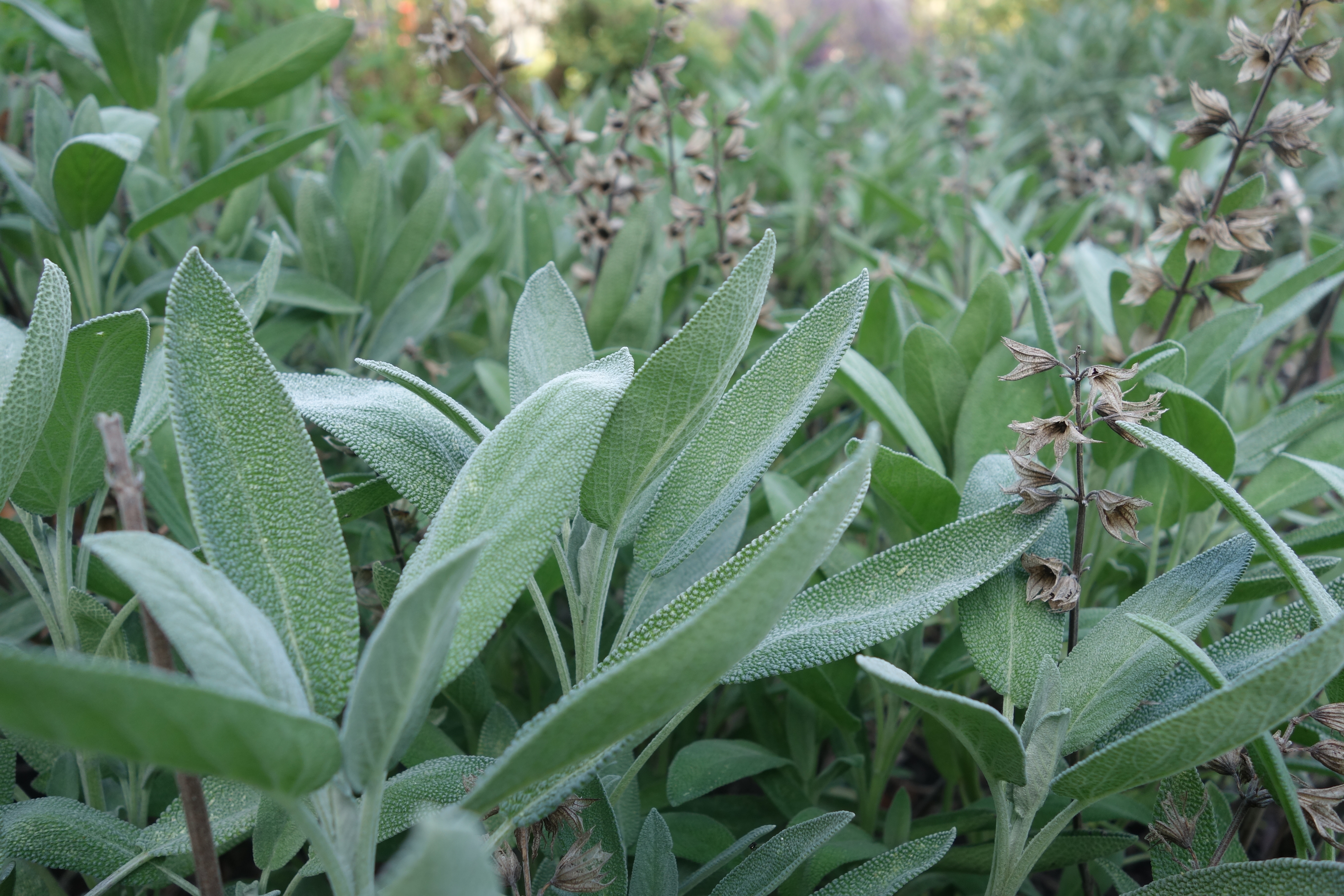
An aromatic culinary infusion that must not be generalized to every plant called sage.
Being Tea Co provides education, not medical advice, treatment, or positive plant identification. Natural does not mean risk-free. Never ingest a wild plant or fungus from a photograph, app result, common name, or this website alone.
Herbs can cause allergic reactions and interact with medicines. Pregnancy, breastfeeding, childhood, surgery, seizure history, kidney or liver conditions, and other health factors can change what is appropriate. Ask a qualified clinician or pharmacist about your own situation.
At a glance
| Scientific name | Salvia officinalis |
|---|---|
| Exact part | Labeled culinary leaf |
| Safety class | Starter kitchen · buy or grow |
| Source | Labeled culinary plant or packaged food-grade leaf |
| Season | Fresh during active growth; dried year-round |
| Broad region | Garden plant across much of North America |
Research lead—not positive identification or permission to harvest.
Identity
- The label should say Salvia officinalis.
- Use ordinary culinary leaf, not essential oil.
- Do not assume sagebrush, white sage, Russian sage, ornamental Salvia, or another “sage” has the same chemistry or use.
Lookalikes and exclusions
The word “sage” spans unrelated or chemically different plants. A common name alone is not enough to select an ingredient.
Do not proceed if
- The scientific name, exact plant part, or maturity stage is uncertain.
- A dangerous or confusing lookalike has not been ruled out with current regional sources.
- The landowner or land manager has not expressly allowed collection.
- The population is sparse, protected, stressed, culturally sensitive, or needed by wildlife.
- Road runoff, spraying, industrial history, pet waste, polluted water, mold, or other contamination is possible.
- Your allergy, pregnancy, breastfeeding, childhood, surgery, health-condition, or medication questions have not been resolved.
Where and when
Grow from labeled seed or a nursery plant, or buy packaged culinary sage. This starter page does not recommend wild collection.
Harvest ethics
If growing it, take a small number of healthy leaves and leave enough growth for the plant. Avoid buying culturally sensitive wild-harvested plants under a vague “sage” label.
Culinary and traditional context
Culinary sage belongs to Mediterranean food traditions and later garden traditions elsewhere. Kitchen ritual can honor scent, memory, clearing, or boundaries as symbolic practice without claiming the cup alters health or fate.
What the research can—and cannot—say
NCCIH says evidence is too limited to draw firm conclusions about sage for health conditions. Some Salvia officinalis contains thujone, which can be toxic at high doses or with prolonged exposure.
Side effects and interactions
- Avoid ingesting sage essential oil.
- Do not treat daily high-quantity use as equivalent to seasoning food.
- Avoid medicinal use during pregnancy. Use extra caution with seizure history, medicines, or planned surgery.
Preparation
Use a packaged culinary-tea direction when available. For an occasional house cup, start with 1 teaspoon loosely filled dried Salvia officinalis leaf in 250 mL just-boiled water, cover, steep 5 minutes, and strain. Keep the serving modest and occasional.
Kitchen ritual & folklore
Write any protective, cleansing, or remembrance association as folklore or personal practice—not as detoxification, antimicrobial treatment, or proof of a physiological effect.
Folklore and personal ritual are presented as cultural or reflective practices. They are not evidence that an ingredient changes physiology, treats illness, predicts events, or is safe for a particular person.
Sources and review
- NCCIH: Sage
- Penn State Extension: Growing Herbs in the Garden
- European Medicines Agency: Salvia officinalis Leaf Monograph
Editorial safety review: July 29, 2026. Re-check linked sources, local rules, and product labels before use; evidence and regulations change.
 Being Tea Co
_Hortus_Botanicus_Leiden_(NL)_2.jpg)