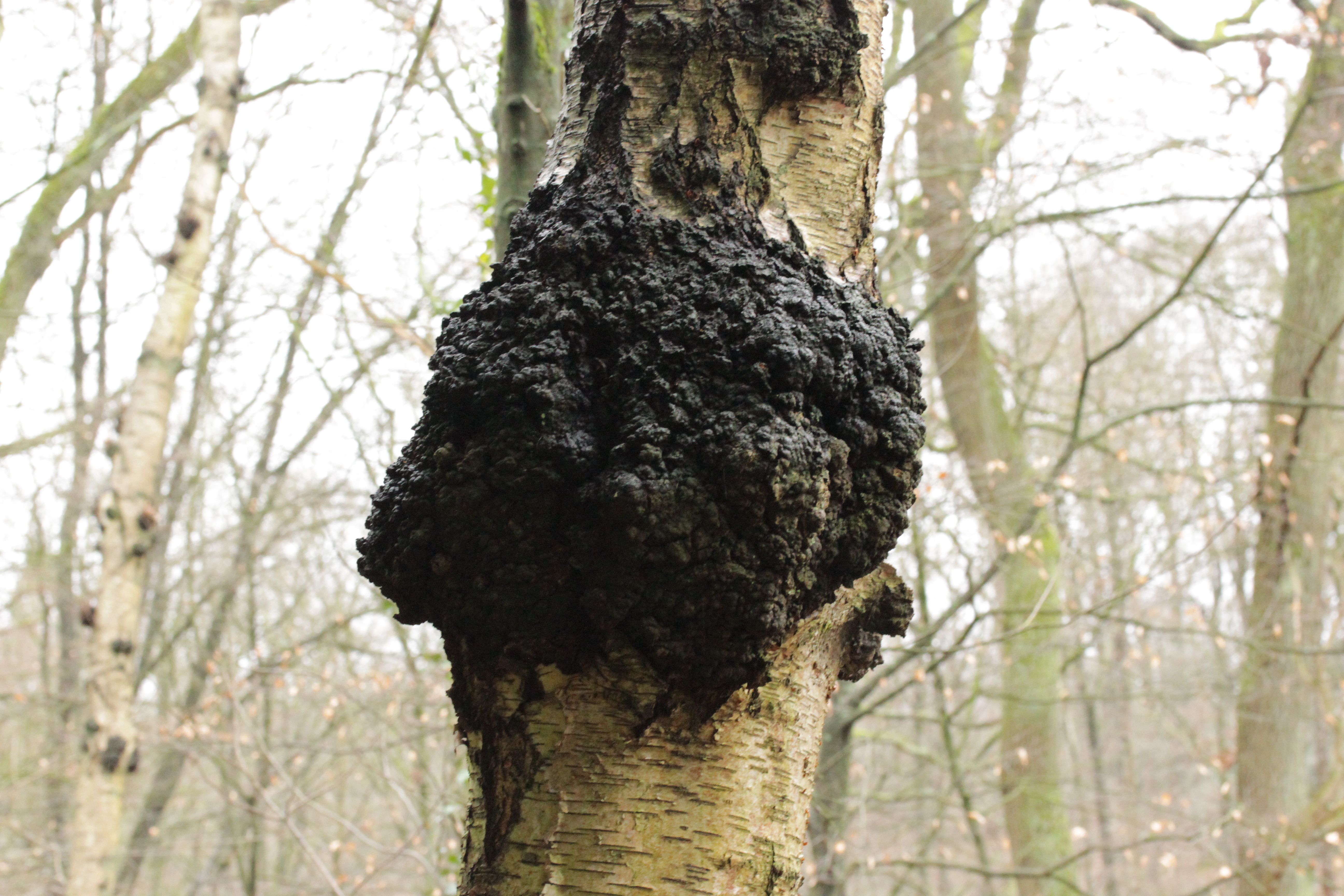
A culturally interesting fungus surrounded by overstated health claims, identification errors, medication concerns, kidney-injury case reports, and sustainability questions.
Being Tea Co provides education, not medical advice, treatment, or positive plant identification. Natural does not mean risk-free. Never ingest a wild plant or fungus from a photograph, app result, common name, or this website alone.
Herbs can cause allergic reactions and interact with medicines. Pregnancy, breastfeeding, childhood, surgery, seizure history, kidney or liver conditions, and other health factors can change what is appropriate. Ask a qualified clinician or pharmacist about your own situation.
At a glance
| Scientific name | Inonotus obliquus |
|---|---|
| Exact part | Sterile conk on a living birch—education only |
| Safety class | Learn only · do not self-harvest as a beginner |
| Source | Traceable purchased material or expert-led study |
| Season | Visible year-round; often easier to locate in winter |
| Broad region | Northern birch forests |
Research lead—not positive identification or permission to harvest.
Identity
- Chaga forms a black, cracked sterile conk with a rusty-gold interior, usually on a living birch.
- A burl, wound, fire scar, or another conk can look similar to a beginner.
- Tree species, living condition, conk structure, interior, site, and local expert review all matter.
Lookalikes and exclusions
Do not make a beverage from a black growth on a tree because an app or social post calls it chaga. Fungal identification from images is not enough.
Do not proceed if
- The scientific name, exact plant part, or maturity stage is uncertain.
- A dangerous or confusing lookalike has not been ruled out with current regional sources.
- The landowner or land manager has not expressly allowed collection.
- The population is sparse, protected, stressed, culturally sensitive, or needed by wildlife.
- Road runoff, spraying, industrial history, pet waste, polluted water, mold, or other contamination is possible.
- Your allergy, pregnancy, breastfeeding, childhood, surgery, health-condition, or medication questions have not been resolved.
Where and when
Northern range and winter visibility are not permission or proof of identity. Chaga can be uncommon and slow-growing, and land rules differ.
Harvest ethics
Observation is the default. Harvest may injure the conk, remove a long-growing resource, or violate land rules. Prefer traceable purchased material or an expert-led outing that explains stewardship and local law.
Culinary and traditional context
Chaga has regional histories of use. Name and cite the community or source. Do not use an Indigenous or folk association as evidence that a modern product treats disease.
What the research can—and cannot—say
No human clinical evidence establishes chaga as a treatment. Laboratory findings do not show that a home drink prevents or cures illness. Published case reports associate heavy chaga powder use with oxalate kidney injury.
Side effects and interactions
- Potential glucose-lowering and antiplatelet effects raise medication and surgery concerns.
- Kidney disease, stone history, diabetes medicines, blood thinners, pregnancy, breastfeeding, childhood, and surgery require professional review.
- Concentrated powders and extracts are not equivalent to traditional household use.
Preparation
No beginner recipe or dose is published here. If a clinician has reviewed your risks and you still choose chaga, use a traceable food product with its labeled directions; do not self-harvest from an image match.
Kitchen ritual & folklore
Winter observation of birch ecology can be the practice. Leave the conk in place, sketch it, and learn the forest before turning it into a commodity.
Folklore and personal ritual are presented as cultural or reflective practices. They are not evidence that an ingredient changes physiology, treats illness, predicts events, or is safe for a particular person.
Sources and review
- University of Minnesota: Chaga Harvester Handbook
- Memorial Sloan Kettering: Chaga Mushroom
- PubMed: Chaga-Associated Oxalate Kidney Injury Case Report
Editorial safety review: July 29, 2026. Re-check linked sources, local rules, and product labels before use; evidence and regulations change.
 Being Tea Co
.jpg)