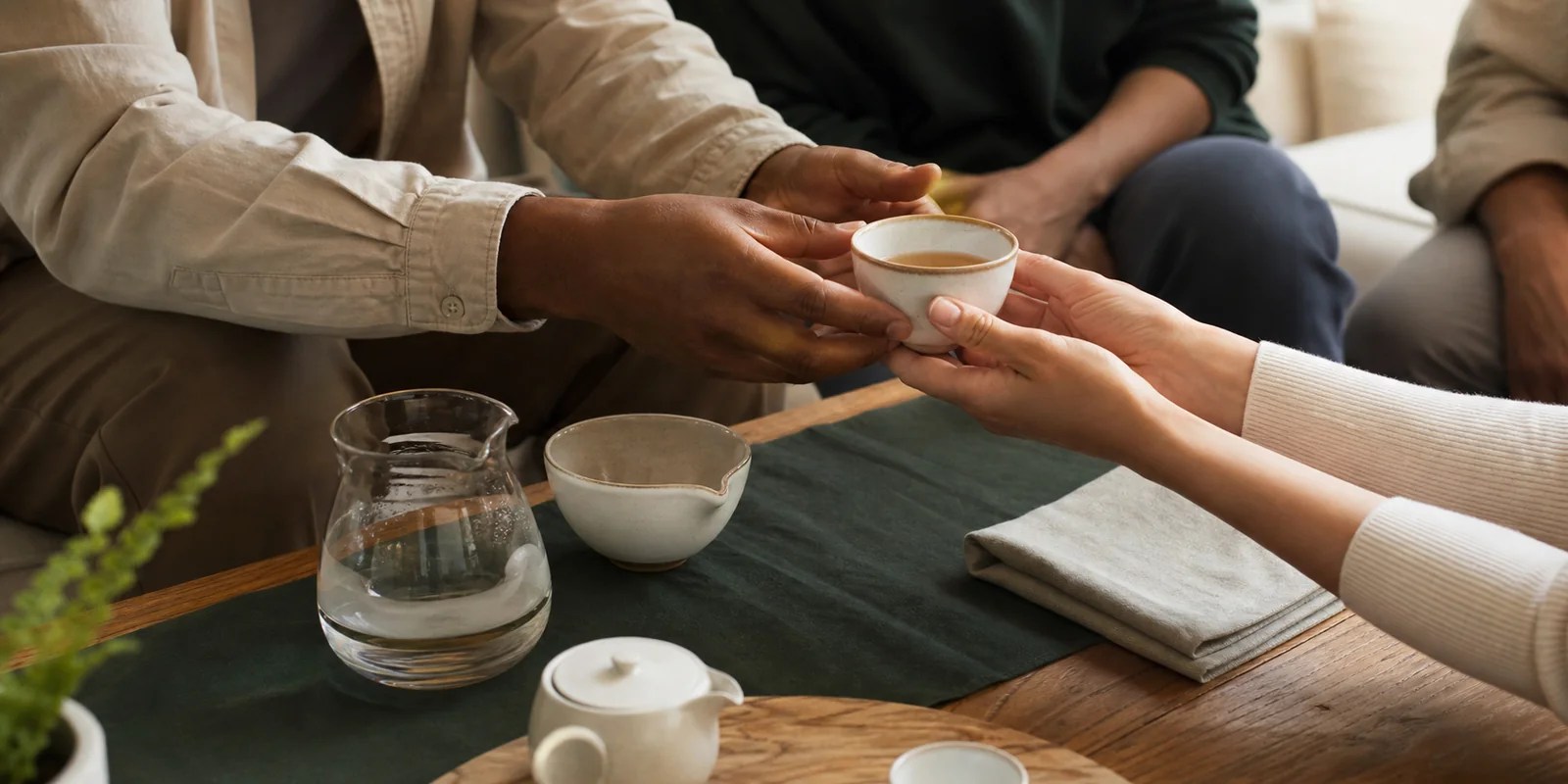
There is no single global “tea ceremony.” To learn well, name the tradition, credit its bearers, and distinguish formal practice from your personal ritual.
9 minutes read · Culture
“Tea ceremony” sounds singular. Tea culture is not.
China contains many regional and community practices around growing, processing, serving, and sharing tea. Japanese chanoyu is a formal, codified practice centered on matcha. Korean tea practices have their own histories and contemporary lineages. Tibetan butter tea, Moroccan mint tea, British afternoon tea, Taiwanese gongfu traditions, and the tea hospitality of Azerbaijan and Türkiye are not variations of one master script.
UNESCO describes tea culture in Azerbaijan and Türkiye as a living social practice of hospitality and relationship, commonly serving hot black tea in pear-shaped cups with sweets, lemon, jams, or dried fruit (UNESCO). Its value is not reduced to brewing technique. It lives in hosts, guests, artisans, farmers, and repeated social acts.
Name the scale of your claim
Compare:
“In the Japanese tea ceremony, people use this bowl.”
with:
“This chawan form is used in chanoyu; the particular school, season, and gathering shape how utensils are selected.”
The second sentence leaves room for knowledge we do not possess. The Metropolitan Museum describes chanoyu as a ritualized practice with codified procedures that requires years of study (Metropolitan Museum of Art). A short social video can introduce it; it cannot confer mastery.
Good cultural writing specifies:
- country, region, or community;
- name of the practice in its own language when known;
- source or teacher;
- whether the example is historical, contemporary, formal, domestic, or commercial;
- what remains outside the writer’s experience.
Ceremony, practice, session, ritual
Use ceremony for a recognized ceremonial tradition or when its bearers use that term. Use practice for a cultivated form with teachings and repetition. Use tea session for a gathering organized around brewing and tasting. Use personal ritual for a routine you created.
These distinctions do not make an informal cup less meaningful. They prevent personal atmosphere from being marketed as inherited authority.
What Being Tea Co. learned from Deer Park
Being Tea Co.’s founder encountered tea within personal experiences at Deer Park Monastery in Escondido, California. Deer Park describes itself as a mindfulness practice and monastic training center in the Plum Village tradition founded by Zen Master Thich Nhat Hanh (Deer Park — About Us).
An archived Deer Park teaching on tea meditation describes being truly present with tea and friends, sitting together in a joyful, serene atmosphere, and allowing sharing to arise without forcing it (Deer Park — Be Mindful in Daily Life).
What we can honestly say is personal:
- slowing down changed how the founder noticed tea;
- shared tea created space for presence and community;
- those experiences continue to inform this independent educational project.
What we should not say:
- that Being Tea Co. represents Deer Park, Plum Village, Buddhism, or Thich Nhat Hanh;
- that ordinary product content is an official monastic teaching;
- that monastery imagery endorses a future shop.
The standing language is: Inspired in part by personal experiences at Deer Park Monastery. Independent and unaffiliated.
Learn without flattening
Avoid the composite “Asian tea ceremony”: a Japanese whisk, Chinese gaiwan, generic bamboo, monk silhouette, and invented calligraphy assembled for mood. It turns distinct living traditions into décor.
Instead, build one clearly sourced lesson at a time. Interview practitioners when possible. Pay teachers and image-makers. Pronounce terms carefully. Link to museums, cultural institutions, and community sources. Correct mistakes publicly.
UNESCO’s account of Chinese tea heritage emphasizes that knowledge is transmitted through families and apprenticeships and held by farmers, producers, artists, and other community members (UNESCO). Credit should follow that living chain.
A respectful home tea pause
You do not need to imitate a formal ceremony to bring attention to tea.
- Clear one small space.
- Put away the phone for one infusion.
- Notice the dry leaf and water.
- Brew without rushing.
- Offer the first complete cup to your guest, if you have one.
- Drink in quiet for three breaths.
- Share what you actually notice, without performing expertise.
Call this a Being Tea Co. tea pause—or simply having tea.
Hospitality before performance
In many tea cultures, the central achievement is not a flawless photograph. It is welcome. Ask whether the guest wants caffeine, how strong they like tea, whether they have allergies to accompaniments, and whether they prefer silence or conversation.
The respectful host does not trap a guest inside a ritual they did not request. The respectful learner does not claim a lineage they have not received. Tea can be deeply meaningful while our language remains modest.
The table grows larger when we name traditions accurately. Specificity does not divide tea culture; it lets each practice arrive with its people and history intact.


Leave a Reply