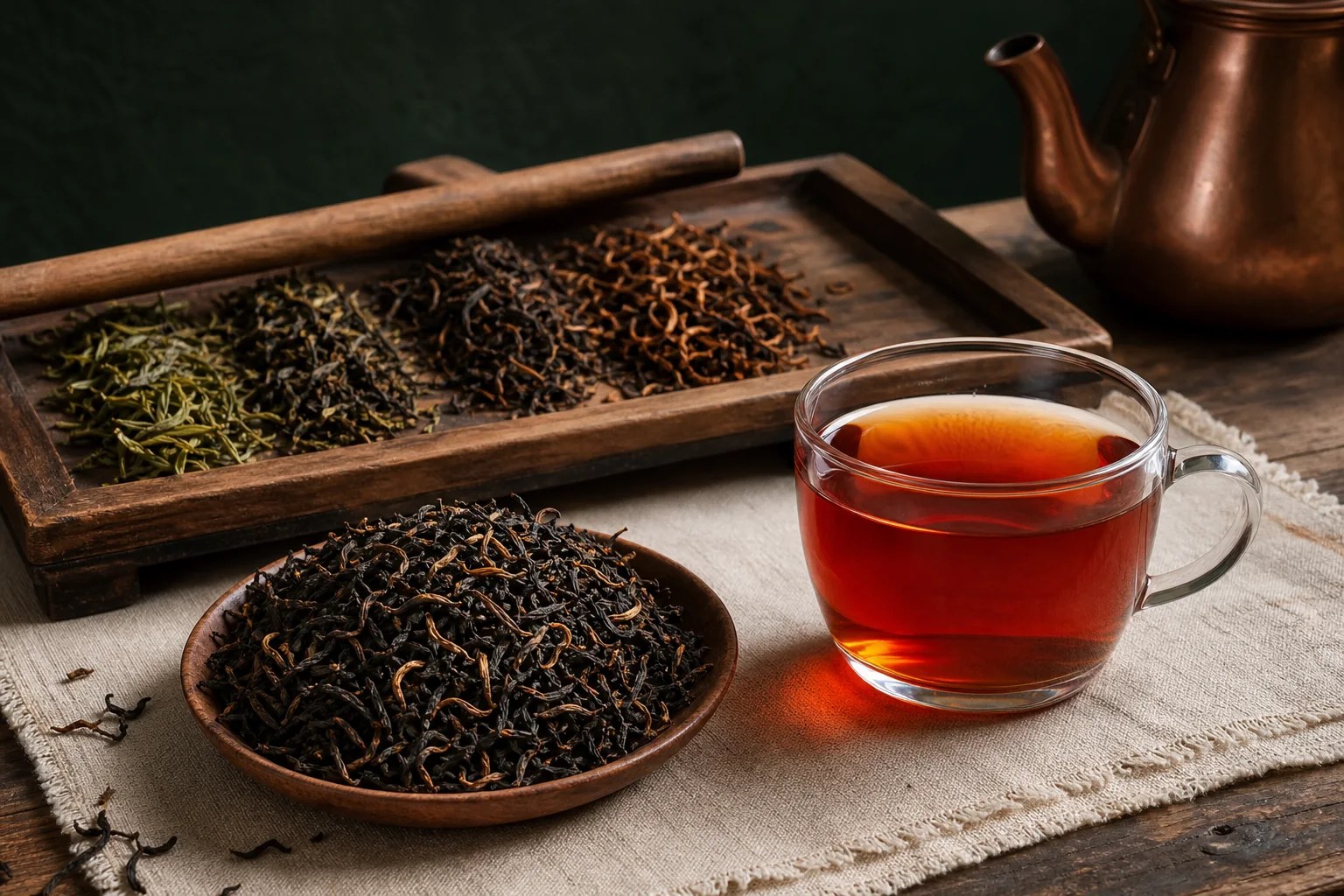
Wither · Roll · Oxidize · Dry
The English black-tea family is hongcha—red tea—in Chinese.
What it is
Black tea is withered, rolled or macerated, extensively oxidized, then dried. In Chinese it is hongcha, “red tea,” after the liquor; heicha, “dark tea,” names the separate post-fermented family.
How it is made
- Wither
- Roll, twist or CTC-macerate
- Allow extensive enzymatic oxidation
- Dry and sort
Styles to know
- Qimen / Keemun and Dianhong
- Zhengshan Xiaozhong
- Assam and Darjeeling
- Ceylon regional teas
- Kenyan black tea and Japanese wakocha
In the cup
Whole-leaf orthodox tea and small CTC particles extract very differently. Malt, fruit, flowers, honey, wood and brisk tannin can all belong to this family.
A starting brew
Start with 2.5–3 g per 250 mL at 95–100°C / 203–212°F for 3–5 minutes. Broken or CTC tea usually extracts faster than large whole leaf.
Storage
Use an airtight, opaque, odor-free container in a cool, dry place. Black tea is often stable, but it is not immune to stale air, moisture or kitchen odors.
Questions to ask before buying
- Orthodox leaf or CTC?
- What origin and harvest?
- Are grade letters being used as size descriptors or unsupported quality claims?
 Being Tea Co