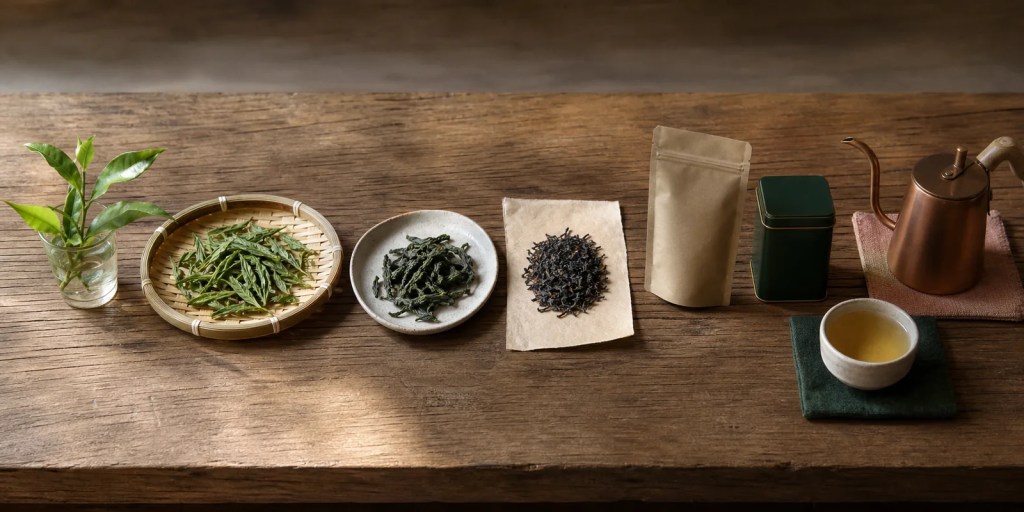
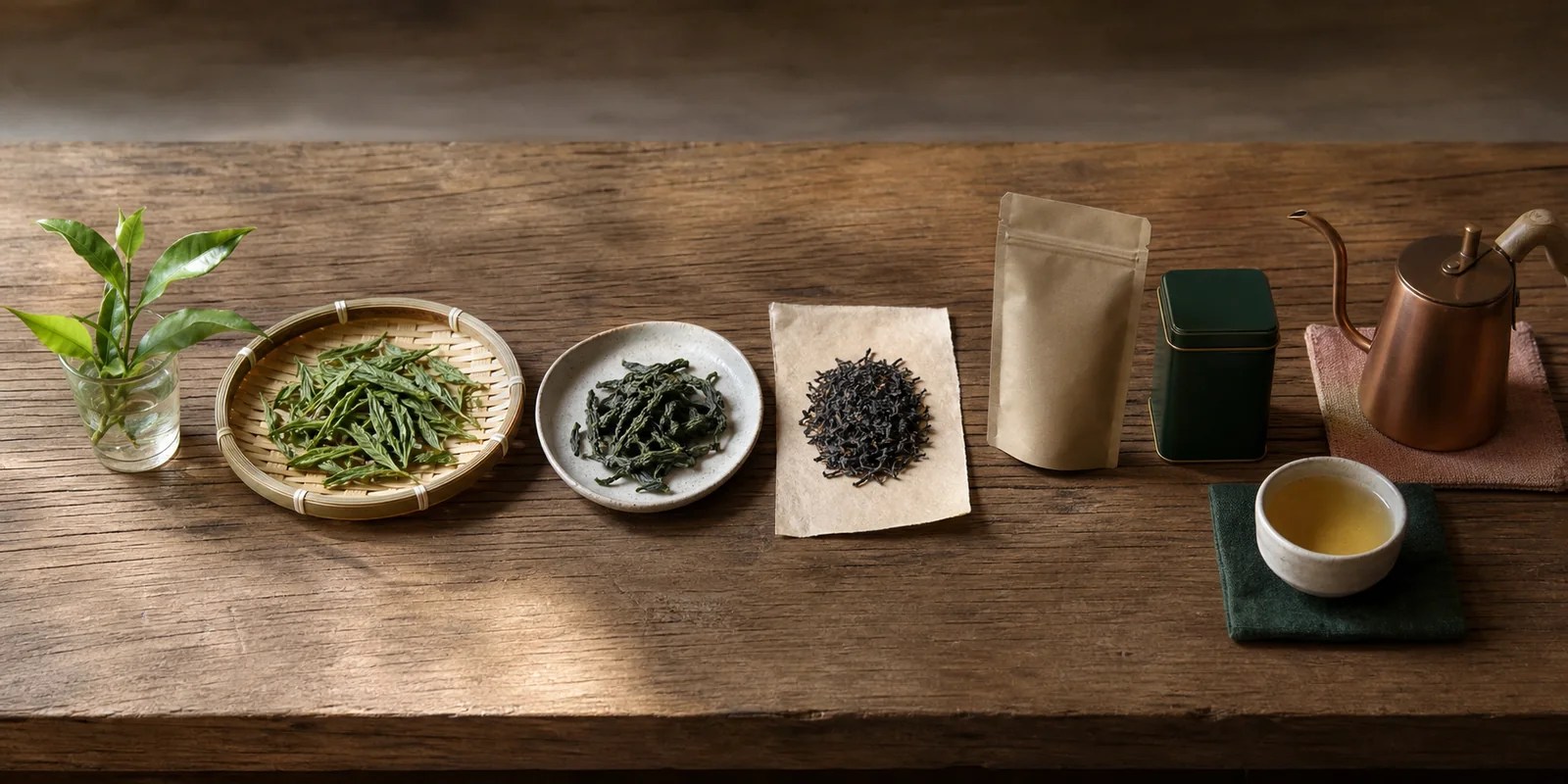
Cultivar, weather, plucking, withering, shaping, oxidation, heat, sorting, packing, storage, water, and service all leave fingerprints on the final infusion.
8 minutes read · Leaf to Cup
A cup of tea may take three minutes to brew and years to become possible.
Before the kettle, there was propagation: a seed or cutting, a nursery, a cultivar selected for local conditions and desired character. Before the package, there were harvesters, makers, sorters, tasters, exporters, importers, and shopkeepers. Tea is not a raw leaf that simply “dries.” It is an agricultural product shaped through a long chain of decisions.
1. Plant and place
Camellia sinensis is an evergreen, but a named tea is more specific than a species. Cultivar, plant age, elevation, shade, rainfall, temperature, soil, pests, pruning, and farming system affect growth. The season and even the weather between harvest days can alter tenderness and chemistry.
Tea also supports livelihoods at enormous scale. The Food and Agriculture Organization says the sector supports more than 13 million people and that smallholders produce a large share of the world’s tea (FAO International Tea Day). “Origin” is therefore not just a flavor word. It names living communities and working landscapes.
2. Harvest
Harvest standards vary. A maker may seek a bud, a bud and one leaf, a bud and two leaves, mature leaves, stems, or a mixture. Hand plucking can make selective harvests possible; mechanical harvest can increase speed and consistency across a field. Neither label alone guarantees flavor. The relevant questions are what was harvested, for which style, under what conditions, and how carefully it was handled.
Fresh leaf begins changing as soon as it is detached. Heat, bruising, compression, delay, and moisture loss influence what happens next.
3. Wither
Withering reduces moisture and makes leaves pliable. It also initiates important aroma changes. Duration, airflow, temperature, humidity, leaf depth, and turning can all matter. White tea may rely heavily on carefully managed withering; black tea uses withering to prepare the leaf for rolling and oxidation.
4. Shape and disrupt
Rolling, twisting, crushing, shaking, or tossing changes shape and can rupture cells. That brings enzymes and substrates together, enabling enzymatic oxidation. A pearl-rolled oolong, needle-shaped green, and twisted black tea do not merely look different: their shapes affect handling and how water later reaches the leaf.
5. Guide oxidation—or limit it
Green-tea makers apply heat relatively early to inactivate enzymes and limit oxidation. Oolong makers repeatedly bruise and rest leaves, guiding partial oxidation and aroma formation. Black-tea makers allow more extensive oxidation before drying. A Washington State University production guide summarizes common steps such as withering, rolling, oxidation, and drying while emphasizing that processing varies by tea and region (WSU Extension).
This is a good place to retire the phrase “fully oxidized.” Black tea is extensively oxidized, but “fully” implies a simple finish line that craft does not always obey.
6. Heat, dry, roast, or ferment
Heating can halt enzymatic oxidation. Drying reduces moisture so tea can be stored. Some teas receive later roasts that reshape aroma and texture. Dark teas may undergo microbial transformation; ripe pu-erh includes a deliberately managed pile-fermentation stage. These processes are distinct, even when everyday tea language calls several of them “fermentation.”
7. Sort and evaluate
Finished leaf may be sifted by size and sorted to remove stems or uneven material, depending on the style. Makers and buyers cup samples for appearance, aroma, liquor, taste, and infused leaf. Sorting is not the moment quality magically appears; it reveals and organizes the results of every earlier decision.
8. Pack and move
Tea easily absorbs moisture and odors. Packaging must protect it from the environment while surviving warehouses, transport, and retail. A beautiful paper box may conceal a useful inner barrier—or no barrier at all. Ask whether the inner package reseals, when the tea was packed, and how the seller stores inventory.
9. Store at home
Most fresh teas benefit from protection from heat, light, moisture, oxygen, and strong smells. Aging teas require their own informed approach; “leave it open so it can breathe” is not universal advice. Storage is part of preparation because a damaged leaf cannot be rescued by a precise kettle.
10. Brew and present
Water composition, temperature, leaf-to-water ratio, vessel, agitation, and time shape extraction. The cup’s material and form influence temperature and aroma perception. Presentation—whether one mug at a desk or a shared tray—sets the social field around the drink.
UNESCO describes tea knowledge in China as encompassing plantation management, picking, manual processing, drinking, and sharing (UNESCO). That breadth is the point. Tea culture is not only what happens after the package opens.
When we pay fairly, ask for provenance, store carefully, brew attentively, and credit living traditions, we participate in the chain rather than pretending the cup began with us.
 Being Tea Co