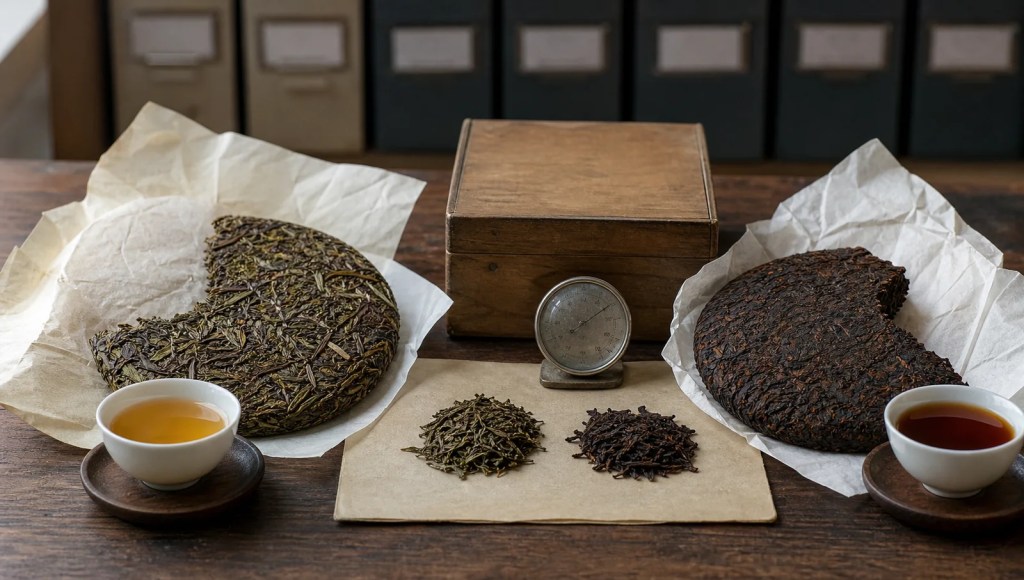
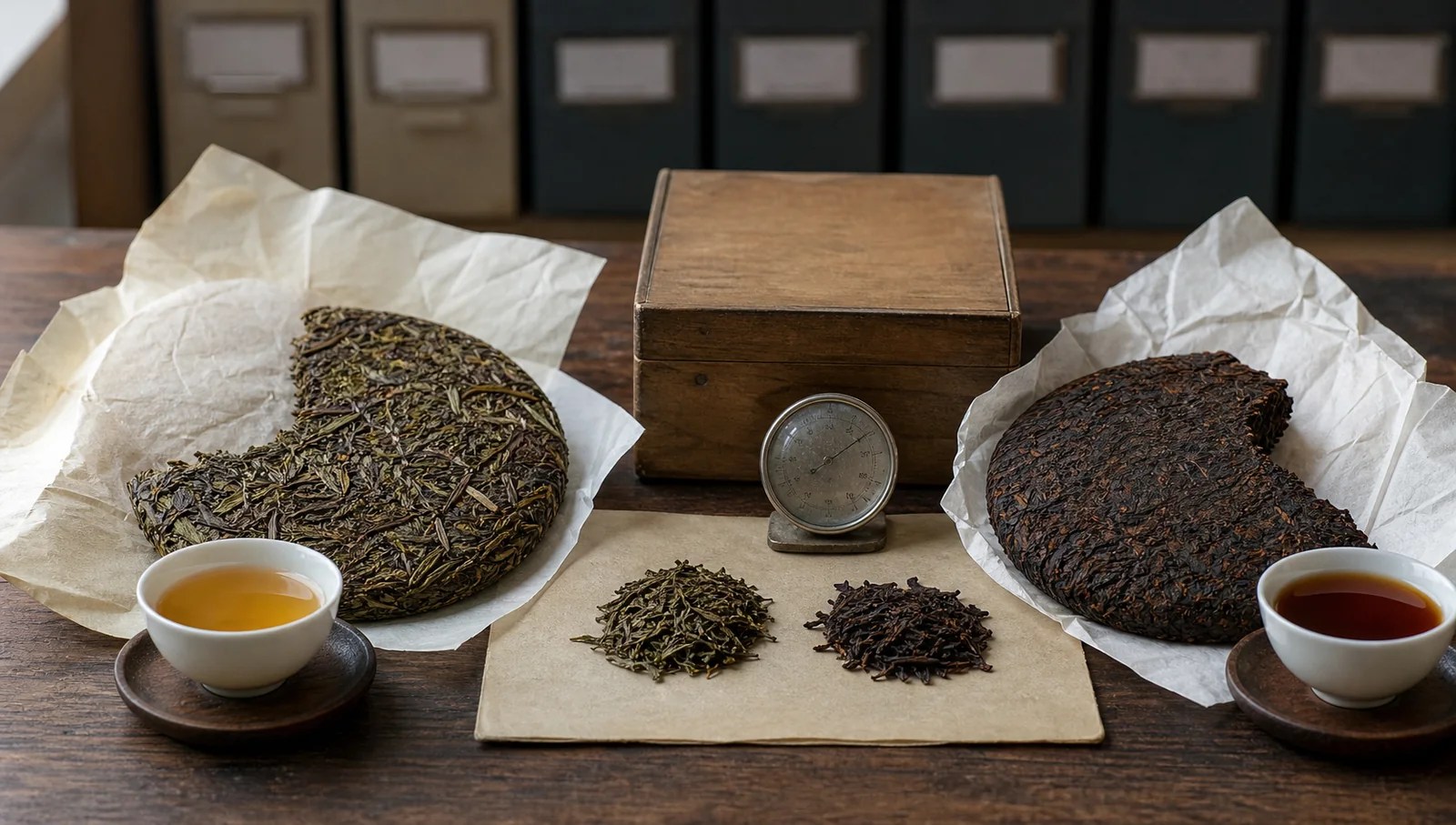
Old does not automatically mean excellent. Start with process, origin, storage, and the evidence behind the wrapper.
9 minutes read · Tea Families
Pu-erh attracts the language of wine cellars, ancient trees, hidden warehouses, and investment-grade cakes. Some of that language points toward real agricultural and cultural depth. Some sells romance by the gram.
Begin with what can be known.
Pu-erh is associated with Yunnan and is commonly divided into raw (sheng) and ripe (shou) processes. A microbiology study describes raw pu-erh as withered, heated, rolled, sun-dried material that can then transform during storage. Ripe pu-erh adds a managed pile-fermentation stage, developed to accelerate a dark, mellow profile through microbial activity (The Microbiome and Metabolites in Fermented Pu-erh Tea).
Raw does not become ripe with age. They remain different processing paths.
Raw pu-erh
Young raw pu-erh can be bright, floral, fruity, vegetal, bitter, astringent, sweet in the finish, and energetic in structure. Over time, oxidation and microbial and chemical changes may soften or transform it, depending strongly on starting material and storage environment.
“Aged” is incomplete information. Ten years in a hot, humid warehouse and ten years in a cool, dry home are not the same ten years. Neither is universally better; they produce different trajectories and different risks.
Ripe pu-erh
Ripe pu-erh undergoes wet piling under controlled heat and moisture. Good examples may suggest dark wood, earth after rain, date, cocoa, or warm grain, with low sharpness and a deep red-brown liquor. Poor examples may taste muddy, fishy, stale, or contaminated. Airing can dissipate some storage aromas, but it cannot redeem mold or unsafe handling.
Ripe tea can change in storage, especially as fresh pile aromas settle, but it is not merely “fake old raw.” It is its own craft.
What age really does
Researchers studying long-term ripe pu-erh find measurable shifts in metabolites and sensory properties, including changes in bitterness, astringency, sweetness, thickness, and aroma. They also state that “older is better” remains an empirical belief with unanswered questions about ideal periods and consistency (2026 aging study).
Age can add rarity because old inventory cannot be recreated. It does not certify pleasant storage, authentic labeling, good leaf, or a flavor you will enjoy.
The phrase generational pu-erh should therefore trigger curiosity, not automatic trust:
- What is the production year?
- Which factory, village, or producer?
- Is it raw or ripe?
- What material and region are claimed?
- Who held it, and where?
- Is the wrapper original?
- Can the seller provide batch evidence and a sample?
The living landscape behind the name
Pu-erh is not only a product category. UNESCO’s Cultural Landscape of Old Tea Forests of Jingmai Mountain describes a tea-growing system developed for more than a thousand years by Blang and Dai communities, integrating old tea groves, forests, villages, traditional governance, and belief (UNESCO World Heritage Centre).
That history deserves more than an “ancient tree” sticker. Respectful buying names communities and avoids turning Indigenous stewardship into anonymous luxury atmosphere.
Buy samples before stories
For a first exploration, buy 10–25 gram samples of:
- a young raw pu-erh;
- a raw tea with several years of documented storage;
- a clean, accessible ripe pu-erh.
Use the same vessel and water. Try 5 grams per 100 milliliters with near-boiling water and short repeated infusions. A brief rinse can help open compressed leaf and remove loose surface dust, but it is not a reliable decaffeination method.
Observe the dry leaf, warmed aroma, liquor clarity, texture, finish, and spent leaf. Stop if you see active fuzzy growth, smell a persistent musty-basement odor, or suspect contamination. White frost-like crystals and harmless aging phenomena are sometimes discussed by collectors, but a photograph is not a safety test; when in doubt, do not drink it.
Storage is part of provenance
Temperature and relative humidity shape microbial communities and chemical change in dark tea (storage-humidity study). Home aging is therefore not “put it on a shelf and wait.” Excess moisture risks mold; extreme dryness can stall transformation and flatten aroma; kitchen odors can enter the leaf.
For most beginners, buying well-stored tea from a transparent specialist is safer than engineering a humid microclimate. Keep pu-erh away from odors, sunlight, condensation, and uncontrolled dampness. Monitor rather than mythologize.
Pu-erh becomes more interesting when the fog clears. Raw and ripe. Plant and process. Community and landscape. Custody and storage. Cup and preference. The real story is complex enough; it does not need invented age.

