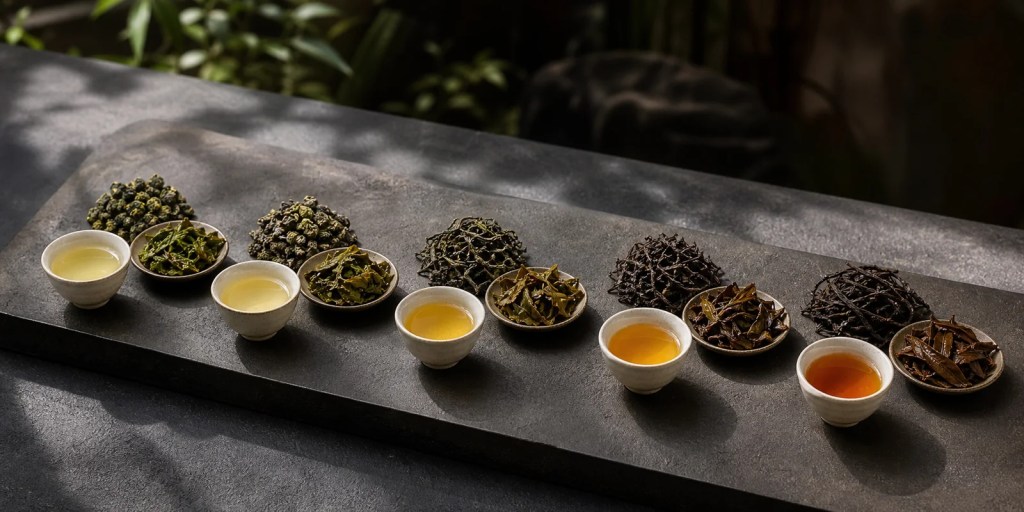
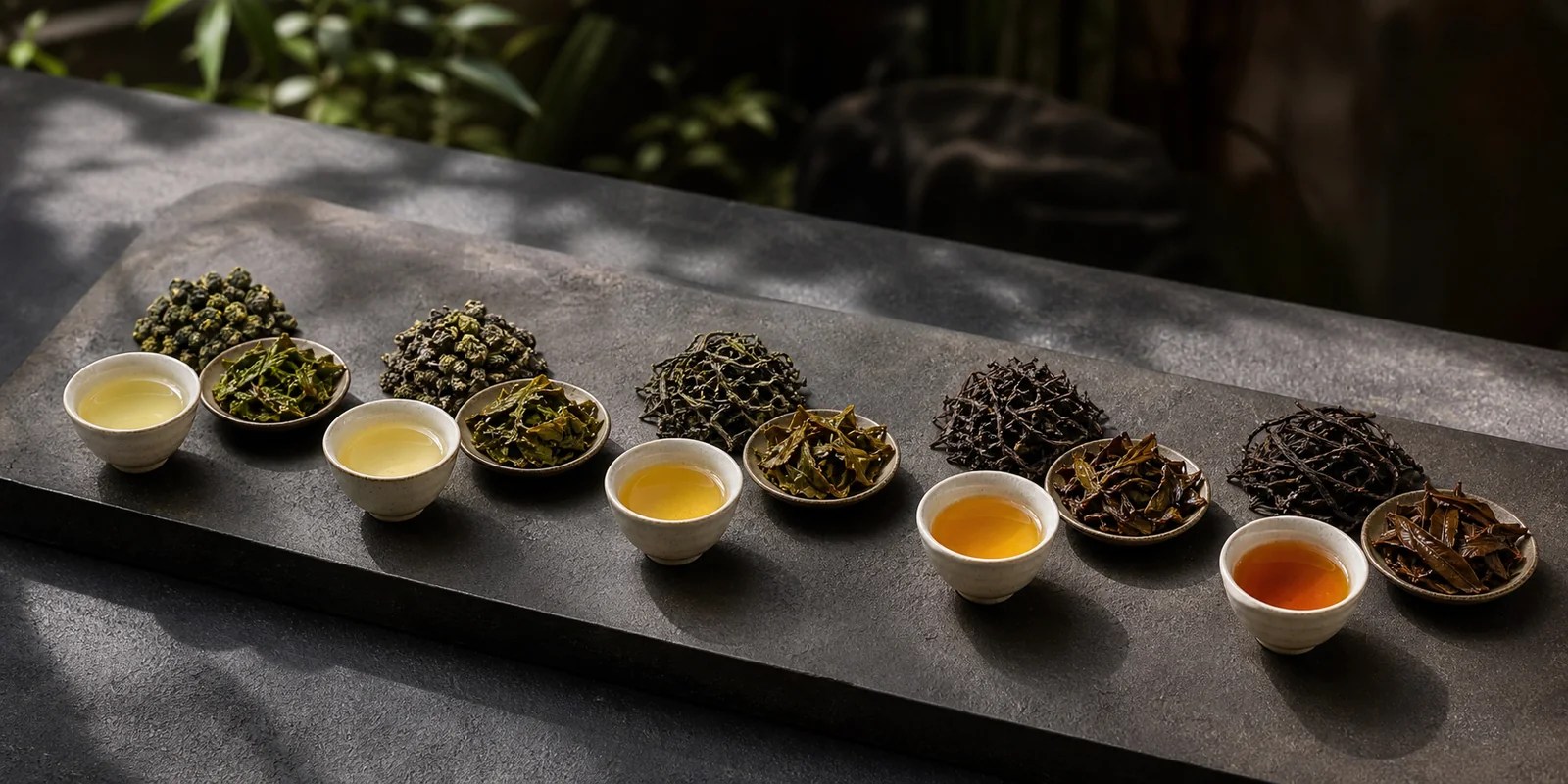
Partial oxidation is only the beginning. Cultivar, bruising, roast, shape, and repeated infusions make oolong one of tea’s broadest territories.
8 minutes read · Tea Families
“Oolong” is sometimes explained as the tea between green and black. That is true in the way a continent is between two oceans: geographically useful, experientially incomplete.
Oolongs are partially oxidized teas created through highly varied traditions of withering, bruising, resting, shaping, heating, roasting, and sometimes aging. A bright, ball-rolled Tieguanyin and a dark, twisted Wuyi rock tea can look and taste so different that a new drinker may not believe they share a family.
UNESCO’s overview of traditional Chinese tea processing places oolong among six broad tea categories and notes the enormous diversity of products created by different natural conditions and local customs (UNESCO).
The craft of the edge
After harvest, oolong leaf is typically withered and deliberately disturbed—tossed, shaken, rolled, or bruised. The damage is not necessarily even. Leaf edges may oxidize more while the center stays greener. Makers alternate movement and rest, reading fragrance and leaf condition before applying heat to arrest enzymatic activity.
The result cannot be reduced to a reliable percentage printed on a package. “20% oxidized” may be a seller’s useful shorthand, but oxidation is spatially and chemically complex. Taste the tea rather than treating a number as a flavor guarantee.
Four axes that help
Oxidation. Lighter oxidation often preserves fresh floral or green notes; greater oxidation may bring ripe fruit, honey, and deeper color. This is a tendency, not a rule.
Roast. Roasting can add toast, nut, caramelized, mineral, or warm spice impressions. A recent roast may sit on top of the leaf; rest can integrate it. “Dark” can therefore describe roast, oxidation, or both—ask which.
Shape. Ball-rolled leaves open over several infusions. Twisted strips often release aroma earlier. Shape changes the pace of extraction, not merely appearance.
Place and cultivar. Anxi Tieguanyin, Wuyi yancha, Phoenix dancong, Taiwanese high-mountain oolong, and many other traditions are not flavor presets. Each contains variation in site, cultivar, season, and maker.
FAO recognizes the Anxi Tieguanyin tea culture system as a Globally Important Agricultural Heritage System, one example of the link among farming knowledge, biodiversity, community, and tea craft (FAO).
Brew for a sequence, not a single verdict
Oolong rewards repeated infusions because the leaf’s shape and aromatic development can unfold gradually.
Try 5 grams in a 100-milliliter gaiwan or small pot. Begin around 90°C / 194°F for a greener oolong or near boiling for a roasted or tightly rolled one, then make a short first infusion of roughly 15–25 seconds. Pour it completely. Add time as the leaves open.
These are exploratory numbers. If the first cup is sharp, shorten or cool. If it is silent, use hotter water, more time, or more leaf. Smell the warmed dry leaf, the wet lid, the liquor, and the empty cup. Aroma compounds are shaped by cultivar, environment, processing, and storage, and some register at very low sensory thresholds (review of tea volatiles).
Record how the tea changes:
- infusion one: first fragrance and structure;
- two and three: expansion and peak intensity;
- later infusions: sweetness, mineral sensation, softening, or fade.
The “best” infusion may not be the strongest.
About the golden light
Many lightly or moderately oxidized oolongs produce the clear gold Being Tea Co. uses as its signature image. Look for brightness, but do not force every oolong toward one color. Roasted and more oxidized examples may pour amber or copper; cloudy liquor may reflect particles or water chemistry rather than failure.
The golden-light question is broader: Does this cup feel clear in its intention? Can you distinguish aroma, taste, texture, and finish, or has one brewing variable flattened them?
Buy with useful questions
Ask the seller:
- origin and cultivar;
- harvest season and year;
- roast level and approximate roast date;
- shape and recommended brewing style;
- whether re-roasting or aging is expected.
Avoid promises that a named mountain or cultivar automatically creates greatness. Provenance gives context; tasting evaluates the particular tea.
Oolong is not one bridge between green and black. It is a landscape of maker decisions. Enter through any cup—orchid-bright, cream-soft, fruit-rich, cliff-roasted—and let successive infusions show how wide the territory is.

