Tag: oolong

  • Oolong Is a Spectrum: From Floral Lift to Roasted Depth

    Oolong Is a Spectrum: From Floral Lift to Roasted Depth

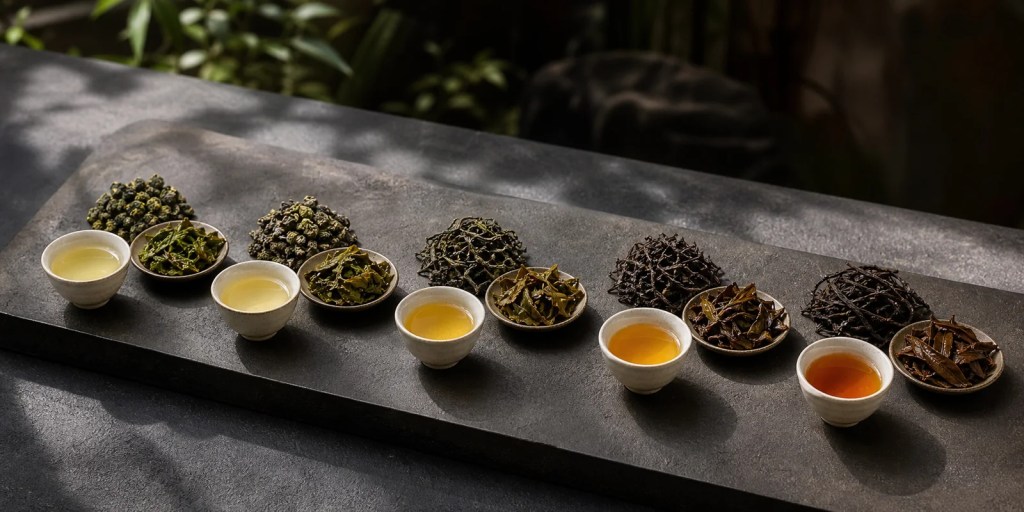
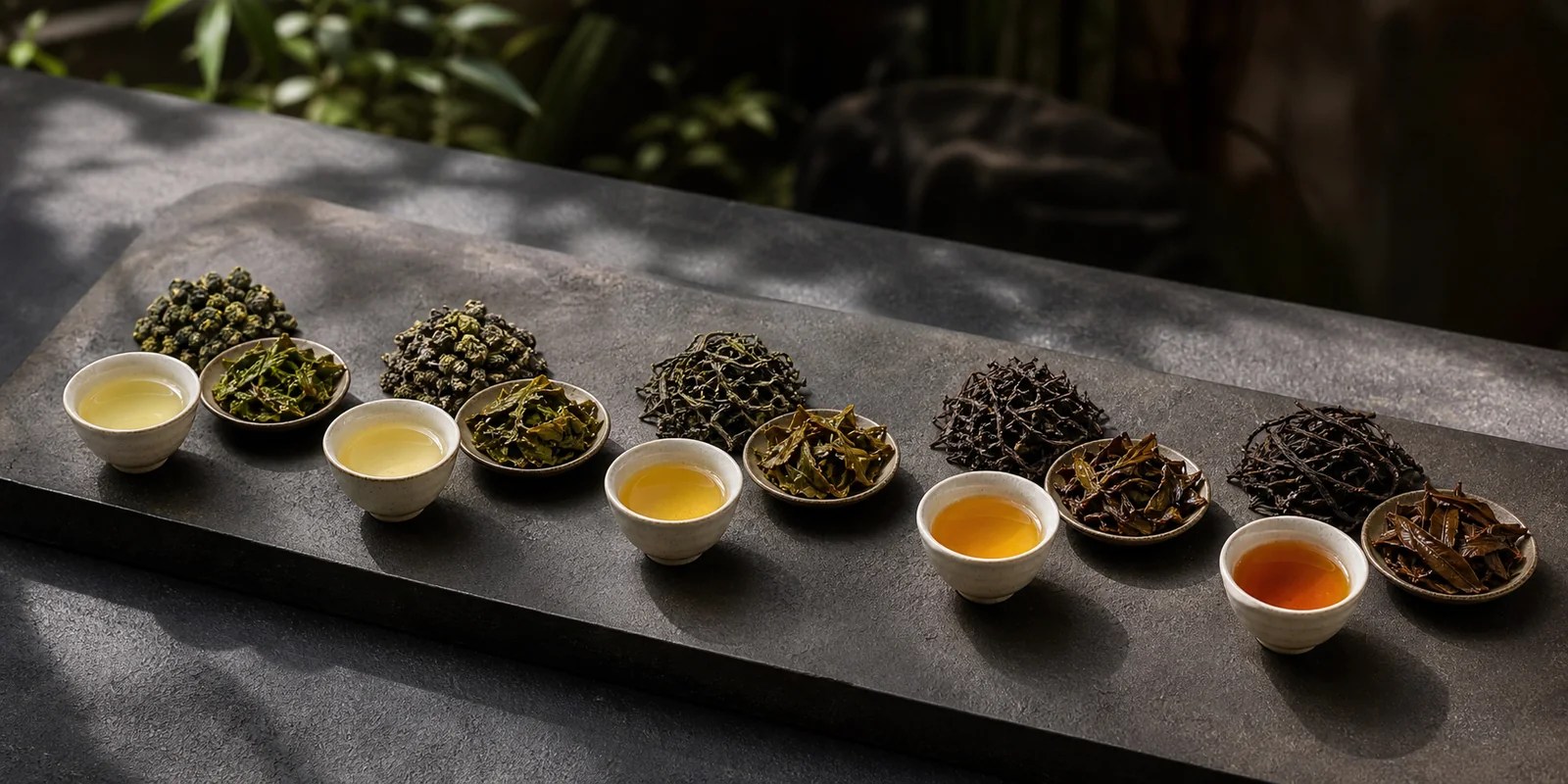
    Light rolled oolong and dark twisted oolong connected by a row of changing infusions.

    Partial oxidation is only the beginning. Cultivar, bruising, roast, shape, and repeated infusions make oolong one of tea’s broadest territories.

    8 minutes read · Tea Families

    “Oolong” is sometimes explained as the tea between green and black. That is true in the way a continent is between two oceans: geographically useful, experientially incomplete.

    Oolongs are partially oxidized teas created through highly varied traditions of withering, bruising, resting, shaping, heating, roasting, and sometimes aging. A bright, ball-rolled Tieguanyin and a dark, twisted Wuyi rock tea can look and taste so different that a new drinker may not believe they share a family.

    UNESCO’s overview of traditional Chinese tea processing places oolong among six broad tea categories and notes the enormous diversity of products created by different natural conditions and local customs (UNESCO).

    The craft of the edge

    After harvest, oolong leaf is typically withered and deliberately disturbed—tossed, shaken, rolled, or bruised. The damage is not necessarily even. Leaf edges may oxidize more while the center stays greener. Makers alternate movement and rest, reading fragrance and leaf condition before applying heat to arrest enzymatic activity.

    The result cannot be reduced to a reliable percentage printed on a package. “20% oxidized” may be a seller’s useful shorthand, but oxidation is spatially and chemically complex. Taste the tea rather than treating a number as a flavor guarantee.

    Four axes that help

    Oxidation. Lighter oxidation often preserves fresh floral or green notes; greater oxidation may bring ripe fruit, honey, and deeper color. This is a tendency, not a rule.

    Roast. Roasting can add toast, nut, caramelized, mineral, or warm spice impressions. A recent roast may sit on top of the leaf; rest can integrate it. “Dark” can therefore describe roast, oxidation, or both—ask which.

    Shape. Ball-rolled leaves open over several infusions. Twisted strips often release aroma earlier. Shape changes the pace of extraction, not merely appearance.

    Place and cultivar. Anxi Tieguanyin, Wuyi yancha, Phoenix dancong, Taiwanese high-mountain oolong, and many other traditions are not flavor presets. Each contains variation in site, cultivar, season, and maker.

    FAO recognizes the Anxi Tieguanyin tea culture system as a Globally Important Agricultural Heritage System, one example of the link among farming knowledge, biodiversity, community, and tea craft (FAO).

    Brew for a sequence, not a single verdict

    Oolong rewards repeated infusions because the leaf’s shape and aromatic development can unfold gradually.

    Try 5 grams in a 100-milliliter gaiwan or small pot. Begin around 90°C / 194°F for a greener oolong or near boiling for a roasted or tightly rolled one, then make a short first infusion of roughly 15–25 seconds. Pour it completely. Add time as the leaves open.

    These are exploratory numbers. If the first cup is sharp, shorten or cool. If it is silent, use hotter water, more time, or more leaf. Smell the warmed dry leaf, the wet lid, the liquor, and the empty cup. Aroma compounds are shaped by cultivar, environment, processing, and storage, and some register at very low sensory thresholds (review of tea volatiles).

    Record how the tea changes:

    • infusion one: first fragrance and structure;
    • two and three: expansion and peak intensity;
    • later infusions: sweetness, mineral sensation, softening, or fade.

    The “best” infusion may not be the strongest.

    About the golden light

    Many lightly or moderately oxidized oolongs produce the clear gold Being Tea Co. uses as its signature image. Look for brightness, but do not force every oolong toward one color. Roasted and more oxidized examples may pour amber or copper; cloudy liquor may reflect particles or water chemistry rather than failure.

    The golden-light question is broader: Does this cup feel clear in its intention? Can you distinguish aroma, taste, texture, and finish, or has one brewing variable flattened them?

    Buy with useful questions

    Ask the seller:

    • origin and cultivar;
    • harvest season and year;
    • roast level and approximate roast date;
    • shape and recommended brewing style;
    • whether re-roasting or aging is expected.

    Avoid promises that a named mountain or cultivar automatically creates greatness. Provenance gives context; tasting evaluates the particular tea.

    Oolong is not one bridge between green and black. It is a landscape of maker decisions. Enter through any cup—orchid-bright, cream-soft, fruit-rich, cliff-roasted—and let successive infusions show how wide the territory is.
    Sources

  • Finding the Golden Light: How to Read a Cup of Tea

    Finding the Golden Light: How to Read a Cup of Tea

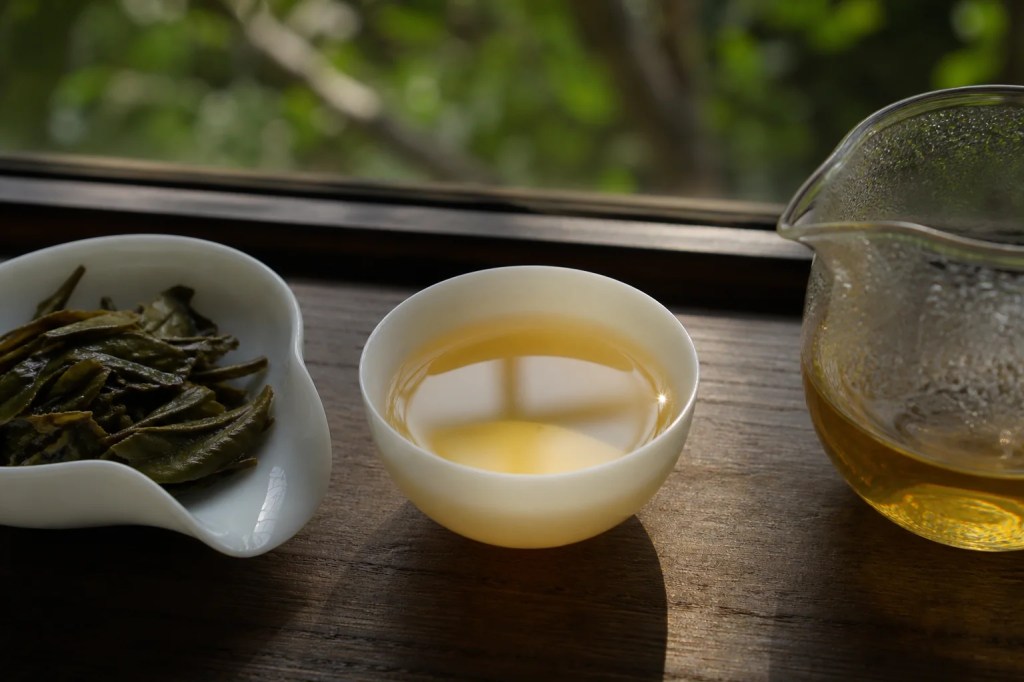
    Clear golden tea catching a small point of sunlight in a white cup.

    Clarity, color, aroma, texture, and aftertaste can tell us how a brew is behaving. “Golden light” is our name for the moment those signals feel balanced—not a universal grade or caffeine test.

    7 minutes read · Brewing

    At Being Tea Co., the golden light is a way of paying attention. It is the clear, lively twinkle a well-balanced oolong or green tea can sometimes show when leaf, water, heat, time, and dilution meet well.

    It is not an industry grade. It is not proof that a tea is expensive. It is not a scientific measure of caffeine, chemical safety, or health benefit. Some excellent teas brew pale green, deep red, cloudy from fine particles, or almost colorless. Golden light is our house language for a sensory moment—not a law imposed on every cup.

    Color is information, not a verdict

    Begin by looking through the liquor against a neutral background. Is it pale straw, yellow-green, amber, copper, or burgundy? Does light travel through it? Is the color even from top to bottom?

    Clarity can be beautiful, but cloudiness has many causes. Tiny leaf particles may pass through a filter. Hard-water minerals can interact with tea compounds. A tea rich in suspended material may look hazy while tasting excellent. Research on green tea has found that the mineral content and pH of brewing water can change color, aroma, and taste (Food Chemistry: X study).

    So we do not score a cup with our eyes alone. We use the eyes to form a question: What might have produced what I see?

    Read the cup in five passes

    1. Look. Note hue, depth, brightness, and any suspended leaf material. Avoid “good” and “bad” for the first ten seconds.

    2. Smell. Take one quiet breath above the cup. Then smell again after the tea cools slightly. Tea aroma is made of volatile compounds, and temperature changes what reaches us. A review from tea researchers at Zhejiang University describes aroma as a central part of sensory quality shaped by cultivar, growing environment, processing, and storage (Recent Advances in Volatiles of Teas).

    3. Sip. Move a small amount across the tongue. Notice sweetness, bitterness, acidity, savoriness, and astringency. Astringency is a drying or gripping sensation, not a flavor and not automatically a flaw.

    4. Feel. Is the liquor thin, silky, brisk, creamy, or coating? Does it seem integrated, or does one feature shout over the others?

    5. Wait. The finish matters. Does fragrance return through the nose? Does sweetness rise after swallowing? Does the mouth feel clean, dry, heavy, or refreshed?

    Balance can be adjusted

    A disappointing first steep is data, not defeat.

    If the cup is harsh, try one change at a time: cooler water, a shorter steep, less leaf, or more water. If it is hollow, try a little more leaf or time. If it is flat despite enough leaf, compare fresh water with the water you used. Lower-mineral, near-neutral water often presents green-tea aroma more clearly, although the best choice remains tea-specific and taste-specific (brewing-water study).

    This is where dilution can be a legitimate flavor tool. Adding a little hot water after brewing may open an overly concentrated cup. It changes concentration and sensation. It does not remove caffeine already extracted, and it does not make unlimited caffeine intake safe. The total caffeine in the serving remains the relevant concern.

    Try the golden-light study

    Choose one green tea or lightly oxidized oolong. Make three small cups with the same water and leaf:

    • Cup A: shorter and cooler than your usual brew
    • Cup B: your normal recipe
    • Cup C: longer or hotter

    Write down only observations: color, aroma, bitterness, astringency, texture, and finish. Then choose the cup that feels most coherent. If none does, change the water or leaf-to-water ratio next time.

    You are not hunting a single “correct” recipe. You are learning how this leaf responds. Published work on steeping shows that time, temperature, and leaf particle size all influence extraction and sensory results (study of white and green teas).

    The golden light is therefore less about achieving a photogenic color than developing a repeatable practice: look, smell, sip, feel, wait, adjust. A good cup becomes not a lucky accident but a conversation you can continue.


    Sources