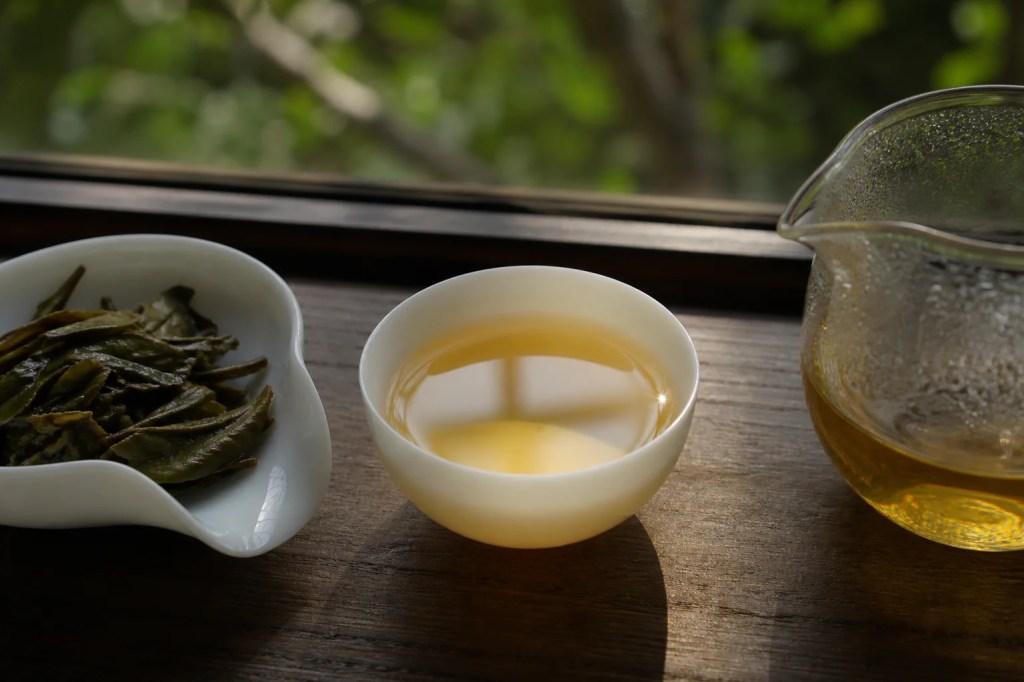
Clarity, color, aroma, texture, and aftertaste can tell us how a brew is behaving. “Golden light” is our name for the moment those signals feel balanced—not a universal grade or caffeine test.
7 minutes read · Brewing
At Being Tea Co., the golden light is a way of paying attention. It is the clear, lively twinkle a well-balanced oolong or green tea can sometimes show when leaf, water, heat, time, and dilution meet well.
It is not an industry grade. It is not proof that a tea is expensive. It is not a scientific measure of caffeine, chemical safety, or health benefit. Some excellent teas brew pale green, deep red, cloudy from fine particles, or almost colorless. Golden light is our house language for a sensory moment—not a law imposed on every cup.
Color is information, not a verdict
Begin by looking through the liquor against a neutral background. Is it pale straw, yellow-green, amber, copper, or burgundy? Does light travel through it? Is the color even from top to bottom?
Clarity can be beautiful, but cloudiness has many causes. Tiny leaf particles may pass through a filter. Hard-water minerals can interact with tea compounds. A tea rich in suspended material may look hazy while tasting excellent. Research on green tea has found that the mineral content and pH of brewing water can change color, aroma, and taste (Food Chemistry: X study).
So we do not score a cup with our eyes alone. We use the eyes to form a question: What might have produced what I see?
Read the cup in five passes
1. Look. Note hue, depth, brightness, and any suspended leaf material. Avoid “good” and “bad” for the first ten seconds.
2. Smell. Take one quiet breath above the cup. Then smell again after the tea cools slightly. Tea aroma is made of volatile compounds, and temperature changes what reaches us. A review from tea researchers at Zhejiang University describes aroma as a central part of sensory quality shaped by cultivar, growing environment, processing, and storage (Recent Advances in Volatiles of Teas).
3. Sip. Move a small amount across the tongue. Notice sweetness, bitterness, acidity, savoriness, and astringency. Astringency is a drying or gripping sensation, not a flavor and not automatically a flaw.
4. Feel. Is the liquor thin, silky, brisk, creamy, or coating? Does it seem integrated, or does one feature shout over the others?
5. Wait. The finish matters. Does fragrance return through the nose? Does sweetness rise after swallowing? Does the mouth feel clean, dry, heavy, or refreshed?
Balance can be adjusted
A disappointing first steep is data, not defeat.
If the cup is harsh, try one change at a time: cooler water, a shorter steep, less leaf, or more water. If it is hollow, try a little more leaf or time. If it is flat despite enough leaf, compare fresh water with the water you used. Lower-mineral, near-neutral water often presents green-tea aroma more clearly, although the best choice remains tea-specific and taste-specific (brewing-water study).
This is where dilution can be a legitimate flavor tool. Adding a little hot water after brewing may open an overly concentrated cup. It changes concentration and sensation. It does not remove caffeine already extracted, and it does not make unlimited caffeine intake safe. The total caffeine in the serving remains the relevant concern.
Try the golden-light study
Choose one green tea or lightly oxidized oolong. Make three small cups with the same water and leaf:
- Cup A: shorter and cooler than your usual brew
- Cup B: your normal recipe
- Cup C: longer or hotter
Write down only observations: color, aroma, bitterness, astringency, texture, and finish. Then choose the cup that feels most coherent. If none does, change the water or leaf-to-water ratio next time.
You are not hunting a single “correct” recipe. You are learning how this leaf responds. Published work on steeping shows that time, temperature, and leaf particle size all influence extraction and sensory results (study of white and green teas).
The golden light is therefore less about achieving a photogenic color than developing a repeatable practice: look, smell, sip, feel, wait, adjust. A good cup becomes not a lucky accident but a conversation you can continue.
 Being Tea Co