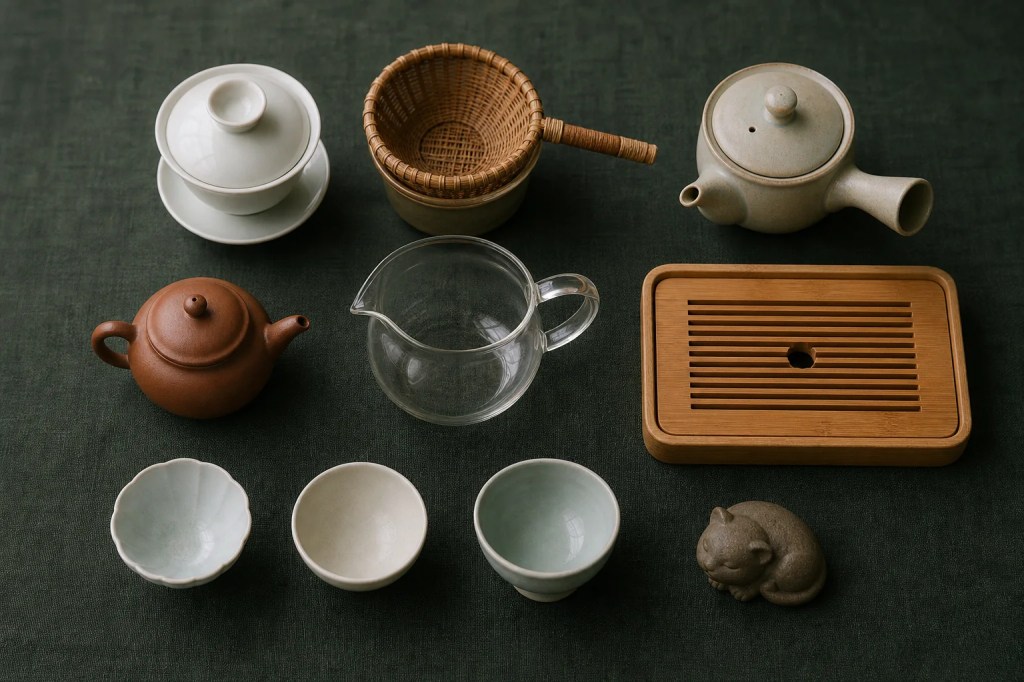
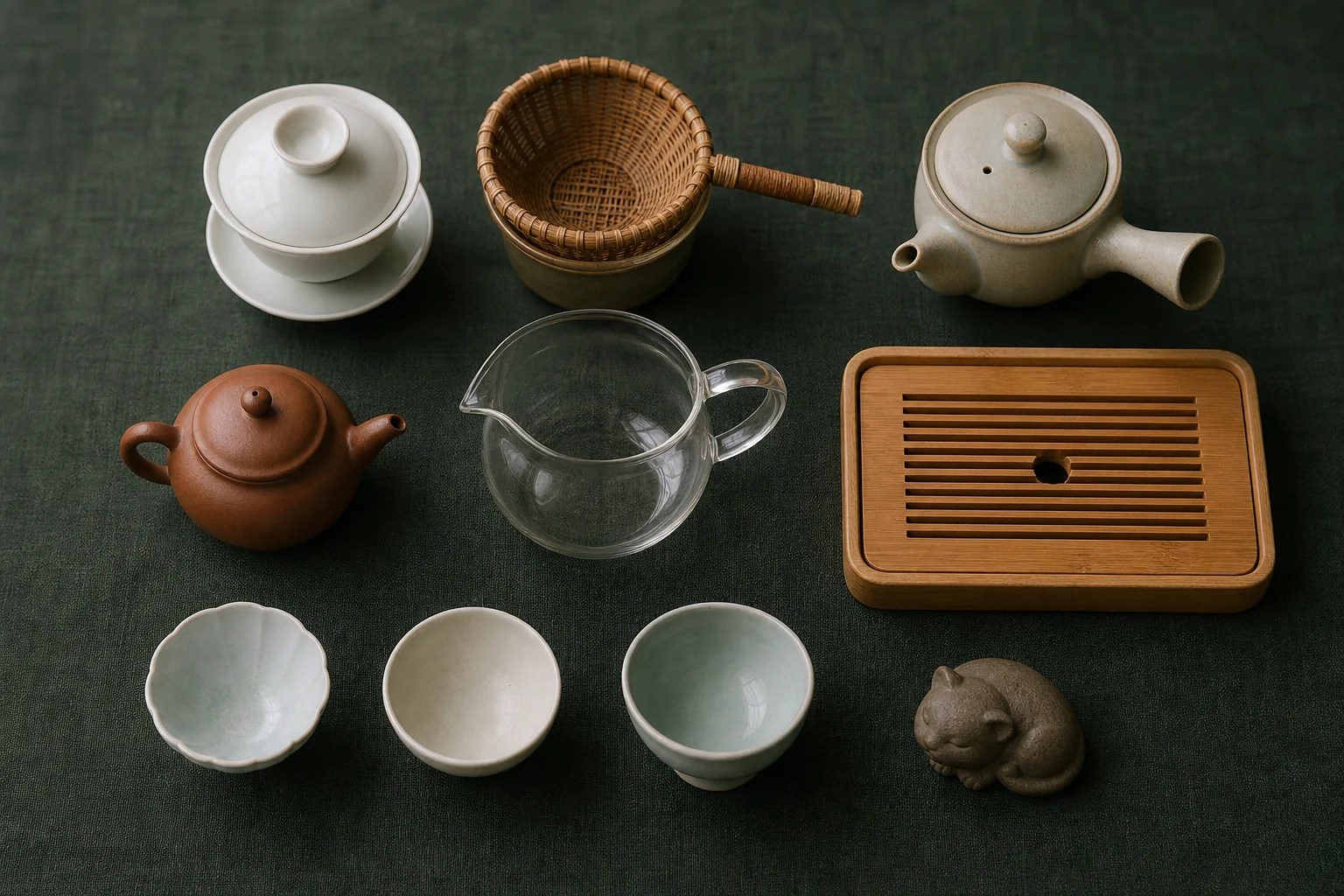
Gaiwan, basket, kyusu, clay pot, fairness pitcher, cups, tray, and tea pet: what each tool does—and what you can skip.
9 minutes read · Teaware
Teaware can be a tool, an artwork, an heirloom, a status signal, or all four. A useful collection begins with a simpler question: What kind of session do I want to make easier?
You can brew excellent tea with a mug and a spacious basket infuser. Everything else should add function, pleasure, cultural practice, or sustained attention—not prove that you belong.
The core vessels
Basket infuser. The most forgiving entry tool. Choose a wide, fine-mesh basket that lets leaf expand and can be removed cleanly. It suits larger mugs, broken leaf, and daily one- or two-infusion brewing.
Gaiwan. A Chinese lidded bowl, typically with saucer, bowl, and lid. It can brew many tea families, pours quickly, and lets you inspect leaf. Porcelain is neutral and easy to clean. Practice with cool water before handling hot liquor; a smaller gaiwan is often easier than a dramatic large one.
Glass or glazed pot. Neutral, observable, and easy to share. A removable basket or built-in strainer prevents oversteeping. Glass loses heat relatively quickly and reveals leaf movement; glazed ceramic offers many heat-retention profiles.
Kyusu. “Kyusu” simply means teapot in Japanese, though abroad it often refers to a side-handled pot used for Japanese green tea. Fine built-in screens suit small steamed leaves. Side handles make low, controlled pouring comfortable.
Unglazed clay pot. Yixing and other unglazed wares can retain traces of aroma and change the brewing experience through clay, geometry, wall thickness, and heat behavior. The British Museum notes Yixing’s long history and the high esteem of its individually made red and brown stonewares (British Museum).
Clay is not an automatic upgrade. Provenance is difficult, counterfeit claims are common, and porous ware requires careful cleaning without scented soap. Learn with porcelain before buying expensive clay; you will know what difference you are paying to hear.
The serving pieces
*Fairness pitcher (gong dao bei or cha hai).* Receives the entire infusion before it is divided, making each guest’s cup more even. It also prevents leaf from continuing to steep while you serve.
Cup. Thin porcelain emphasizes immediate aroma and cools quickly. Thick stoneware holds heat and feels substantial. A tall aroma cup is used in some Taiwanese gongfu contexts; a Japanese chawan is made for whisked tea and is not simply an oversized steeped-tea cup.
Tea bowls carry deep histories. The Metropolitan Museum of Art notes that Chinese Jian-style “hare’s-fur” bowls became prized in Japan, especially among Buddhist monks, and inspired later Japanese production (Met object record). Objects travel and acquire new meanings; name those histories rather than calling every handmade bowl “Zen.”
Tray. A dry tray organizes tools. A drainage tray handles generous rinsing and overflow. Neither is required. If using a drainage tray, empty and clean it promptly so the ritual does not end in stagnant tea.
Small tools and trinkets
Scoop or spoon: keeps hands and moisture out of storage. Tongs: sometimes used to handle small cups; optional at home. Tea needle or pick: separates compressed tea; use a stable surface and direct the point away from your hand. Strainer: catches small particles between pitcher and cup. Tea towel: handles drips and supports a clean table. Tea pet: a small clay figure that receives rinse water in some contemporary gongfu settings. Enjoy it as table companionship, not as a universal ancient requirement. Kettle: the most consequential “accessory.” Prioritize safe handling, a controlled pour, and temperature selection only if you will use it.
Match the tool to the leaf
- Fine steamed green tea: kyusu with a suitable screen, shiboridashi, or fine basket.
- Ball-rolled oolong: gaiwan or pot with room to open.
- Twisted oolong: fast-pouring gaiwan or small pot.
- Broken black tea: basket or pot with a fine strainer.
- Compressed pu-erh: pick, small neutral vessel, and pitcher for repeated infusions.
- Matcha: chawan, whisk, and sifter—part of a distinct powdered-tea preparation.
These are conveniences, not prohibitions.
Respect practice, avoid costume
The Japanese practice of chanoyu is a codified art requiring years of study, not a generic label for any quiet cup. The Metropolitan Museum describes it as ritualized preparation and drinking of matcha in a specialized setting (Met essay). Likewise, gongfu traditions are living, varied practices—not a decorative pile of “Asian” objects.
When demonstrating a tradition, name the place, lineage, teacher, or source. When creating your own routine, call it a tea session. Accuracy is warmer than borrowed authority.
The first useful kit
Start with:
- a reliable kettle;
- a gram scale;
- a basket infuser or 100-milliliter porcelain gaiwan;
- one cup you enjoy holding;
- a small pitcher if you share tea;
- a towel and a notebook.
Add the next object only when you can name the problem it solves or the practice it supports. The best tea setup is not the fullest table. It is the table that makes attention easy.

