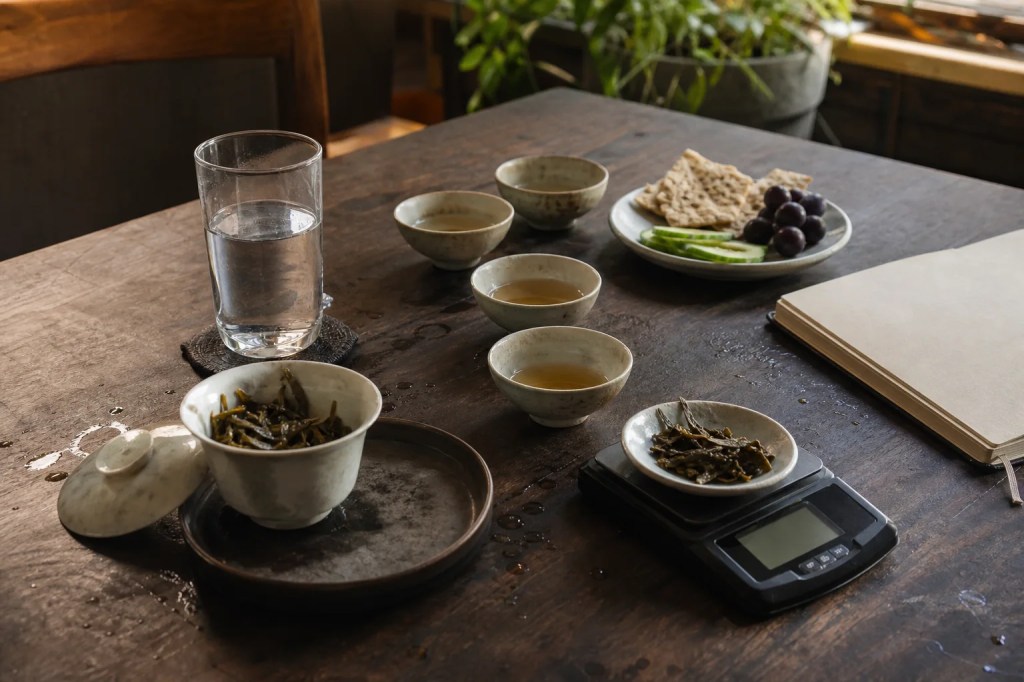
Tea can feel bright, calm, warm, social, or intense. The experience is real to the drinker; the popular explanations are not always proven.
9 minutes read · Tea & Body
Tea drinkers use phrases such as “tea drunk,” cha qi, body feeling, energy, calm focus, floating, warmth, or a sudden social ease. These words point to subjective experience. They do not all mean the same thing, and they do not establish one proven biological mechanism.
Being Tea Co. will treat “tea drunk” as a community term for a noticeable state during or after a tea session—not as a medical condition, supernatural property, or promise that an expensive tea will alter consciousness.
What is definitely in the conversation
Tea from Camellia sinensis contains caffeine and many other compounds, including polyphenols and the amino acid L-theanine (NCCIH). Caffeine is a stimulant. It can increase alertness, but too much can cause jitters, anxiety, insomnia, nausea, headache, increased heart rate, or palpitations.
The FDA cites 400 milligrams per day for most adults as an amount not generally associated with negative effects, while stressing that sensitivity and elimination vary with body, medication, and health conditions (FDA). That is a population-level reference, not a personal target and not permission to push until symptoms appear.
Pregnancy, breastfeeding, certain conditions, and some medications require individualized guidance. Children and teens need different limits. A clinician is the right source for personal medical advice.
Why the cup is hard to calculate
“White tea has the least caffeine” and similar charts are unreliable shortcuts. A study of 20 commercial teas found caffeine ranging from 14 to 61 milligrams per 6- or 8-ounce serving, with no simple category trend across white, green, and black tea (Caffeine content of brewed teas).
The amount in a session depends on leaf, cultivar, harvest material, processing, dose, particle size, water temperature, time, and number of infusions. Package values, when available, are more useful than folklore, but only laboratory testing can establish a particular preparation precisely.
Dilution changes concentration, not the extracted total
Suppose a pot contains 60 milligrams of caffeine. Adding water can make each sip less concentrated and may soften flavor. If you drink the entire diluted pot, it still contains roughly the caffeine that was already extracted. Water does not neutralize caffeine.
Dilution can help pace a session and improve taste. It cannot make “much more caffeine than normal” safe. This distinction is central to our golden-light language: a clear, balanced-looking cup is a sensory achievement, not a caffeine safety indicator.
Likewise, a quick rinse does not reliably remove most caffeine. Extraction begins quickly but continues over time; how much leaves in a rinse depends on the tea and conditions. Discarding flavor to pursue an unverified decaffeination trick is poor risk management.
What about L-theanine?
Tea’s L-theanine is often used to explain “calm focus.” A recent systematic review and meta-analysis found that L-theanine with caffeine may produce small-to-moderate improvements in some attention measures, while many confidence intervals included little or no difference and few studies used tea itself at ordinary tea-equivalent doses (systematic review).
That is interesting evidence, not proof that theanine cancels caffeine or makes unlimited intake safe. Supplements and a brewed cup are not interchangeable.
Context changes the experience
A long tea session also includes:
- repeated warm liquid;
- aroma and taste attention;
- expectation and story;
- pauses in ordinary activity;
- quiet or conversation;
- an empty or full stomach;
- hydration and food;
- the social rhythm of serving;
- caffeine accumulated across many infusions.
Any of these may shape what a person reports. We can honor the experience without pretending to isolate its cause from an armchair.
A safer session practice
If exploring concentrated, repeated infusions:
- eat beforehand unless a clinician has told you otherwise;
- know your usual caffeine sensitivity;
- use small cups and pause between infusions;
- keep water and simple food available;
- count coffee, energy drinks, medication, chocolate, and other caffeine that day;
- stop for palpitations, shaking, nausea, anxiety, dizziness, or feeling unwell;
- do not drive or take risks if you feel impaired for any reason.
This is general caution, not medical treatment. Severe or persistent symptoms require professional help.
Language that keeps wonder and honesty
Instead of:
This ancient tea’s qi lets you drink huge amounts of caffeine safely.
Try:
During the fourth infusion I noticed warmth, a light feeling, and sustained attention. The session was also caffeinated, and individual responses vary.
Instead of:
The golden color proves a perfect extraction.
Try:
This recipe produced a clear gold cup with floral aroma, gentle grip, and a long sweet finish.
Specific sensory language is not less poetic. It is more shareable because another drinker can compare it with their own experience.
Tea can be moving without becoming a miracle claim. Drink for flavor, attention, craft, and company. Let unusual feelings remain reportable, discussable, and bounded by care.

